An extinct species
Triadobatrachus †
Triadobatrachus massinoti
A frog-like relative before powerful leaps.
Lived about 250–247 million years ago.
You and the triadobatrachus meet in the Four-limbed animals branch, shown at about 350 million years ago (on 1 December, in a calendar from life's shared ancestor to today).
The oldest known frog-like fossil still had separate tail bones and was not built for powerful leaps. This early relative was a stem frog, on the frog family line but outside the group containing living frogs and their most recent shared ancestor. It lived about 250 to 247 million years ago, before the first dinosaurs.
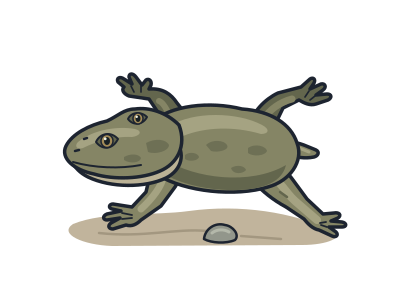
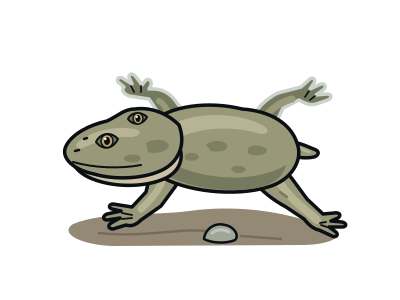
Reconstructions suggested a flat, compact body about 10 centimetres long—roughly the length of a small adult’s palm. Its overall shape was already recognisably frog-like. Yet that familiar outline did not mean it moved like a modern jumping frog.
Comparisons of its limbs suggested that it mainly walked, bending its body from side to side rather like a salamander. Studies of its skeleton suggested that it was not a specialised jumper. These were clues from the preserved skeleton, not movements recorded in stone. They suggested that some parts of the frog body plan appeared before powerful jumping became established.
Separate leg bones
Its two lower-leg bones remained separate, unlike the joined pair in living frogs.
A mould in stone
The fossil was preserved as a natural mould inside a lump of stone split into two halves.
A Madagascar discovery
The museum catalogue recorded its discovery near Betsieka in northern Madagascar.
Next to it on the tree
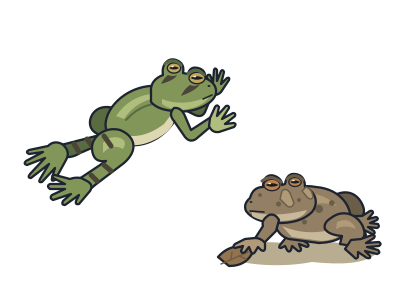
- Frogs and toadsEvery toad is a frog: a body plan built for jumping that has barely changed in 200 million years.
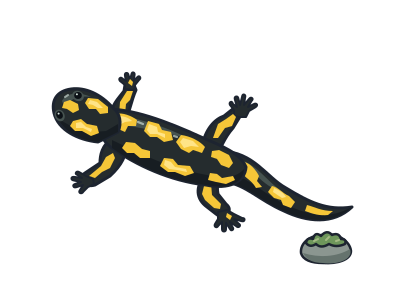
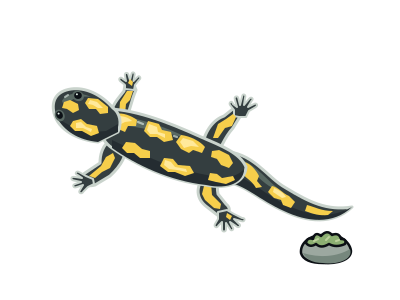
- Salamanders and newtsTailed amphibians, from finger-sized newts to giants longer than a person.
- CaeciliansLegless, burrowing amphibians that look like big earthworms and are rarely seen by anyone.
- EocaeciliaAn early caecilian relative that still had tiny legs, linking caecilians to legged ancestors.