A species
Heat record-holder
Methanopyrus kandleri
The microbe that holds the heat record for life
You and the heat record-holder meet in the Archaea branch, shown at about 3.3 billion years ago (on 20 March, in a calendar from life's shared ancestor to today).
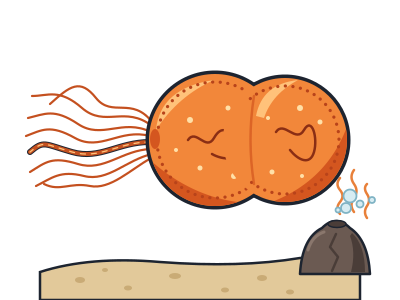
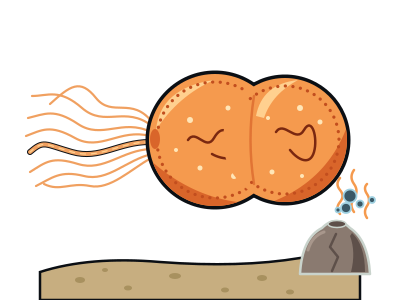
This tiny microbe holds the heat record for life. In a lab, one strain kept growing and multiplying at 122 °C. That is well above the temperature at which water boils in your kitchen. Scientists collected this strain from a hot vent on the floor of the Indian Ocean.
How can anything live in water that hot? Deep under the sea, the huge weight of water above stops it from boiling. Pressure even helped the microbe. At low pressure the strain stopped growing at about 116 °C, but at deep-sea pressure it kept going up to 122 °C. Inside each cell, lots of salt and a special chemical help stop its proteins from falling apart in the heat.
It is not a bacterium. It belongs to the archaea, a separate branch of single-celled life. Its relatives include a methane-maker that lives in the human gut. Like that relative, it gives off methane gas. It needs no sunlight and no food from other living things. Instead, it joins hydrogen gas with carbon dioxide from the vent water and uses the carbon to build its body.
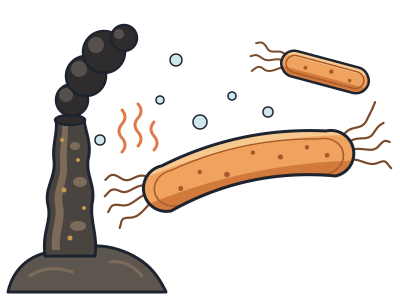
Each cell is a tiny rod that swims with tufts of hair-like whips at one or both ends. It cannot grow where there is oxygen.
Tough beyond growing
At deep-sea pressure it survived more than 3 hours at 130 °C, though it could not grow at that temperature. At normal pressure it lasted about 2 hours.
Clues for other worlds
Researchers say its heat record helps show where life might be able to survive, including on other planets and moons.
A small instruction book
Its full set of genes is small, with about 1.7 million DNA letters and about 1,700 genes for making proteins.
Next to it on the tree
- Gut methane-makerAn archaeon living in most human guts that turns hydrogen into methane.


- Salt-loving archaeaArchaea that turn salt ponds pink and live in brine ten times saltier than the sea.

- Rushing fireballIts name means rushing fireball: it doubles every 37 minutes at 100 °C beside volcanic vents.
- Acid record-holderGrows best in hot soil more acidic than lemon juice, near pH 0.7, the most acid-loving life known.


- MethanosarcinaGrows in clumps and makes methane from many foods, using a rare 22nd building block for its proteins.