A species
Common liverwort
Marchantia polymorpha
A flat green ribbon that uses raindrops to throw its babies
You and the common liverwort meet in the Eukaryotes branch, shown at about 1.8 billion years ago (on 28 July, in a calendar from life's shared ancestor to today).
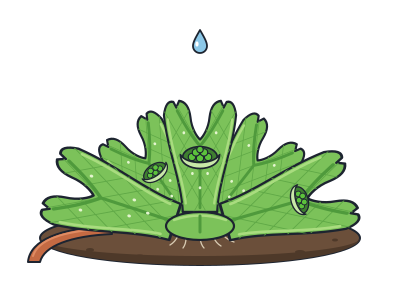
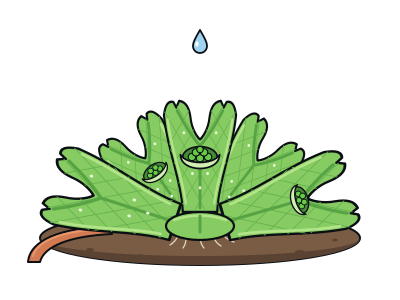
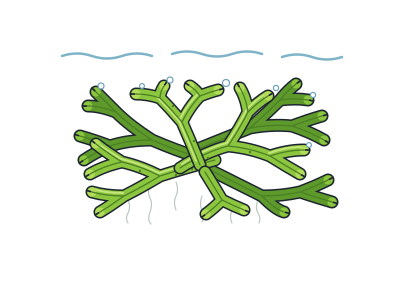
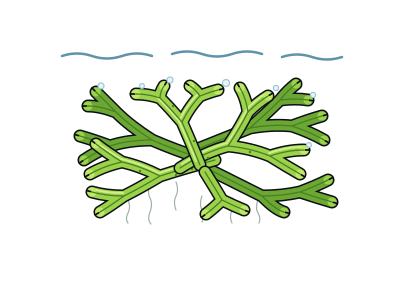
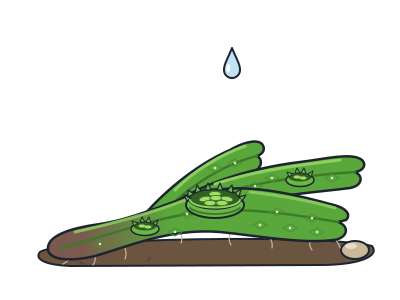
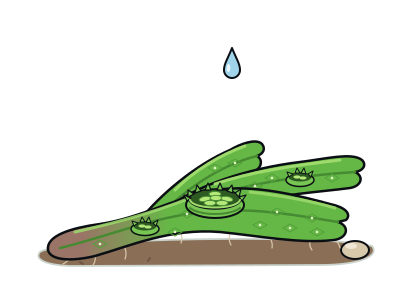
Picture a flat green ribbon lying on wet soil and forking into Y-shapes as it grows. Tiny cups dot its top, each about half a centimetre across and holding a pile of green crumbs. These crumbs, called gemmae, are its babies. When a raindrop lands off-centre in a cup, the splash flings a few of them out. They can land up to about a metre away. Each crumb is a clone of its parent and grows into a new ribbon.
This plant has no true roots, stems or leaves, and no proper veins to carry water. Fine hairs on its underside hold it to the ground. On the tree, its neighbours are the mosses and hornworts, which are also small plants without true veins. People often call it a moss, but it belongs to a separate group.
It also has another way to make offspring. Each plant is either male or female. Males grow tiny stalks topped with flat saucers. Females grow stalks topped with little umbrellas of finger-like rays. Rain helps here too. Drops hitting the male saucers can splash sperm about half a metre, and the sperm then swim through water to reach the eggs.
You can find it in damp places on every continent except Antarctica.
First to return after fire
After big wildfires, it is often one of the first plants to cover bare, burnt soil. It helps stop the soil washing away. Later, other plants crowd it out as the land recovers.
Spores by the hundred thousand
Small capsules form under the female umbrellas, and each can hold up to about 200,000 spores. The spore walls are made of one of the toughest natural materials known.
Why 'liver'?
Its lobed body looks a bit like a liver, so it was named 'liverwort'. Because of that shape, people once used it as a liver medicine, though it has no proven benefit.