A species
Crescent-cup liverwort
Lunularia cruciata
The flat green weed in garden pots that uses raindrops to splash out its buds.
You and the crescent-cup liverwort meet in the Eukaryotes branch, shown at about 1.8 billion years ago (on 28 July, in a calendar from life's shared ancestor to today).
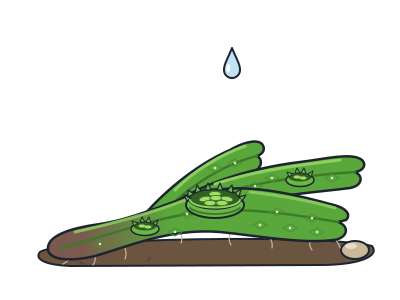
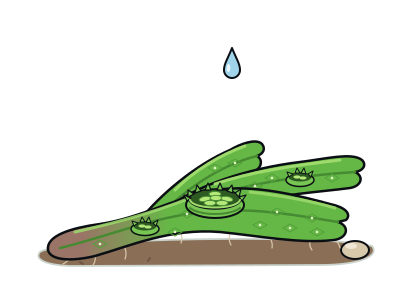
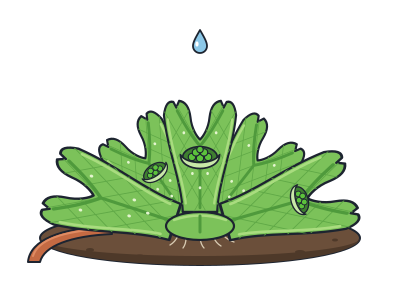
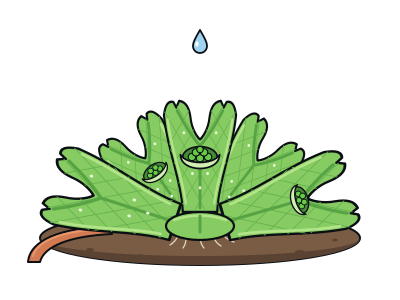
Have you ever seen a flat, pale green crust spreading over the soil in a plant pot? It may well be this liverwort. It is one of the most common liverworts in plant nurseries and glasshouses. Look closely and you will spot tiny half-moon cups on its shiny surface. Each cup is only about 1 to 2 millimetres across.
Those cups are splash cups. Each one holds a little heap of tiny green discs called gemmae. When a raindrop or a splash of water lands in a cup, it flicks the discs out. Each disc can grow into a new plant that is a copy of its parent. Damp, often-watered greenhouses suit it perfectly.
People often call it moss, but it is not one. Liverworts are their own group of simple land plants, related to mosses and hornworts. Its relative the common liverwort grows in the same damp pots, but has round cups instead. No other flat-bodied liverwort has crescent cups like these.
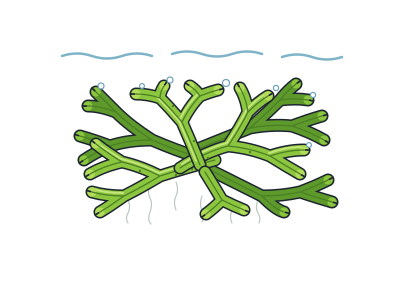
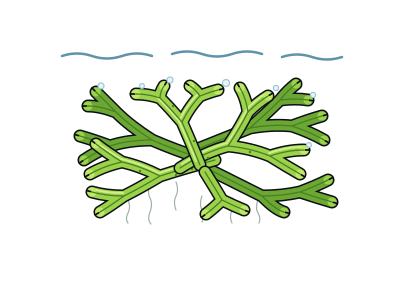
Its body is a flat green ribbon that keeps forking into Y-shapes. It has no true leaves, stems, roots or flowers. Fine threads underneath hold it to the soil.
One of a kind
It is the only species in its genus and the only one in its whole family. Its name comes from the Latin word 'luna', meaning moon, after its half-moon cups.
A Mediterranean traveller
It first came from the Mediterranean region. People carried it around the world, often, it seems, with potted plants. It is now an introduced weed in Australia, and it probably reached New Zealand after 1867.
Its own brake pedal
It makes a natural chemical that slows its own growth. More of it builds up when days are long, and this helps control when the plant rests.