An extinct species
Hurdia †
Hurdia victoria
A huge hood on an ancient arthropod relative
Lived about 510–505 million years ago.
You and the hurdia meet in the Two-sided animals branch, shown at about 580 million years ago (on 11 November, in a calendar from life's shared ancestor to today).
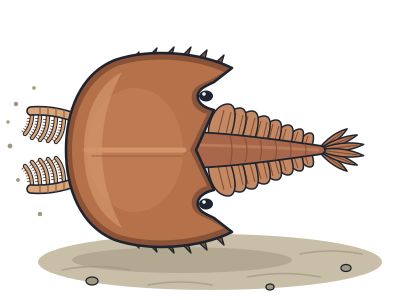
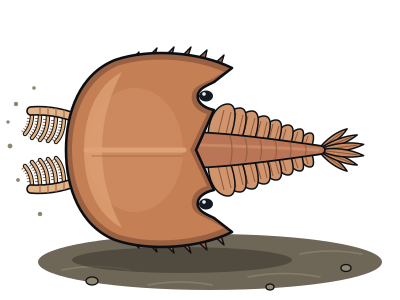
With a huge armoured hood projecting from its head, this relative of Anomalocaris had a striking outline. It lived about 510 to 505 million years ago. Its head covering had three parts: a pointed upper plate and two paddle-shaped side plates. Together, they stretched about as long as its trunk, but did not wrap around its whole body.
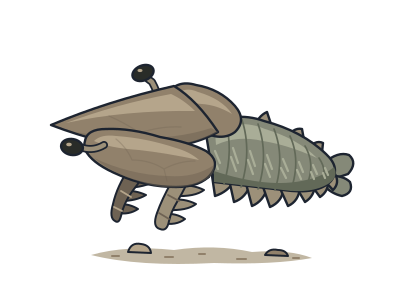
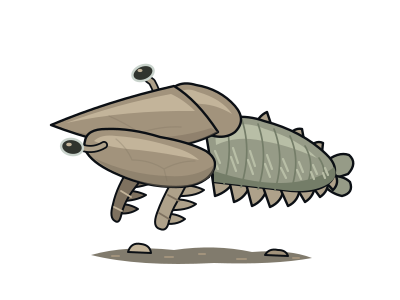
This animal belonged to the radiodonts, an extinct early branch of the wider arthropod group, whose living members include insects, spiders and crabs. Aegirocassis belonged to the same smaller family within that branch. Fossils showed a short, rounded body, swimming flaps and two front limbs carrying sturdy, widely spaced spines.
Its remains were well represented in the Burgess Shale. The museum recorded hundreds of fossils across the Hurdia group, which included more than one species. Most were separate parts rather than whole animals. Complete bodies helped researchers work out how those scattered pieces fitted together.
Eyes on stalks
Two stalked eyes emerged through notches between the head plates.
A plated mouth
Its underside mouth had 32 plates arranged around a square opening.
Delicate details
Some fossils preserved unusually fine details of structures interpreted as gills.
Next to it on the tree
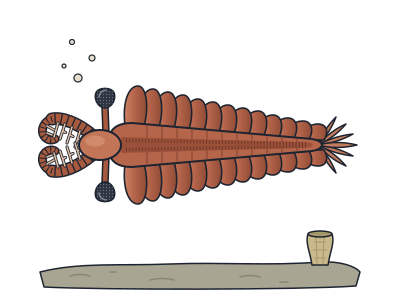
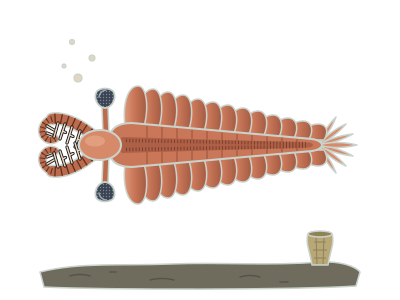
- AnomalocarisOne of the first big predators: a Cambrian hunter longer than a school ruler, with spiny grasping arms.
- AegirocassisA two-metre giant that swept the sea for plankton, like an early whale shark.
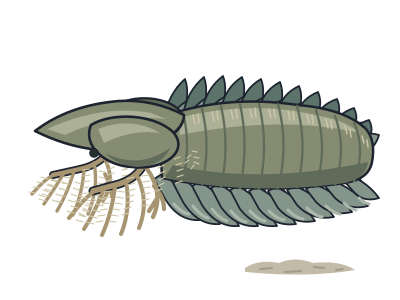
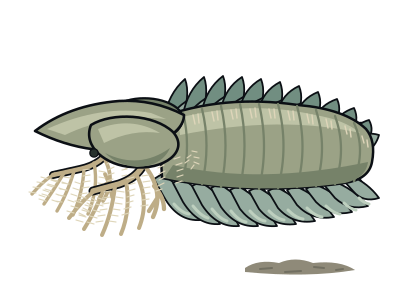
- CambrorasterA radiodont with a huge head shield shaped like a spaceship that raked the seafloor for food.