An extinct species
Aegirocassis †
Aegirocassis benmoulai
A sea giant with a plankton filter, not a hunter’s grip.
Lived about 480–478 million years ago.
You and the aegirocassis meet in the Two-sided animals branch, shown at about 580 million years ago (on 11 November, in a calendar from life's shared ancestor to today).
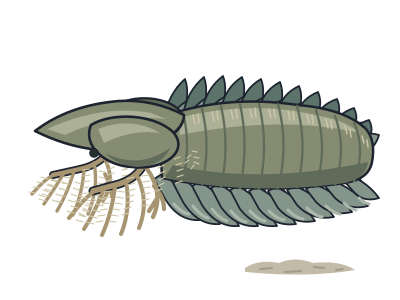
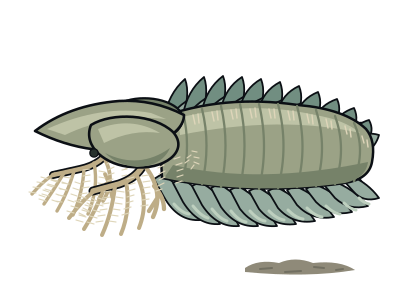
This sea giant was reconstructed at over two metres long—roughly the length of a bed. Yet its finely branched feeding limbs suggested that it filtered plankton, tiny organisms carried by the water, rather than grabbed large prey. It filled a feeding role much like a whale shark, without being closely related to one.
Its known fossils dated from about 480 to 478 million years ago. It belonged to the radiodonts, an extinct branch near the base of the arthropod family tree. Its family connection was therefore with animals such as shrimps, not sharks or whales.
Fossils showed upper and lower pairs of flaps on the first ten segments behind its head. The small final segment had no flaps. These helped researchers understand how the two-branched limbs of shrimps evolved. Fine, blade-like structures near the upper flaps were interpreted as breathing structures. Some fossilised muscles even preserved individual fibres.
Six filtering branches
A 2023 study identified six long filtering branches on each feeding limb, including an outermost branch with a different structure.
A collector honoured
Its name honoured Mohamed Ben Moula, the Moroccan fossil collector who discovered it.
Polar sea, now desert
Its fossil deposits formed offshore near the ancient south polar region. The rocks were later found in desert.
Next to it on the tree
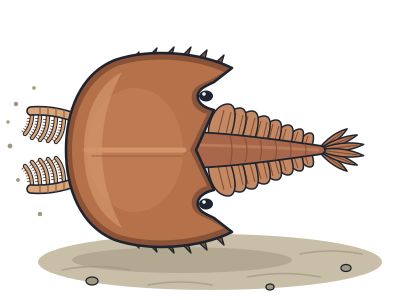
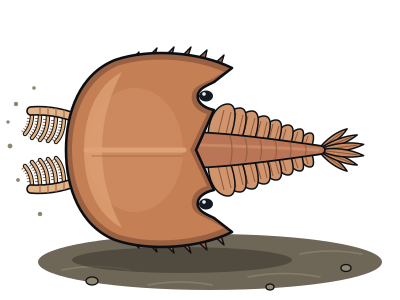
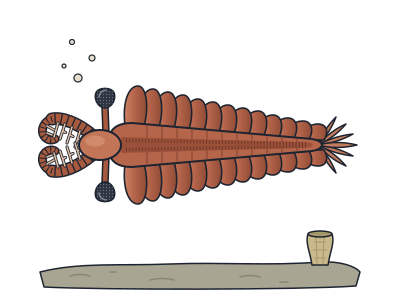
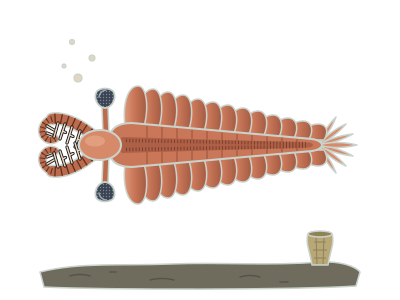
- AnomalocarisOne of the first big predators: a Cambrian hunter longer than a school ruler, with spiny grasping arms.
- HurdiaA radiodont with a huge armoured hood on its head, common in the Burgess Shale.
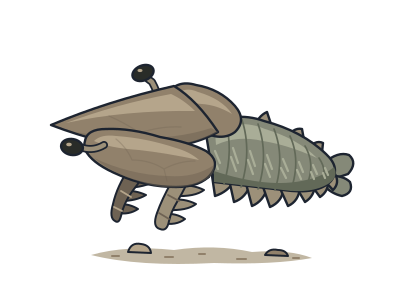
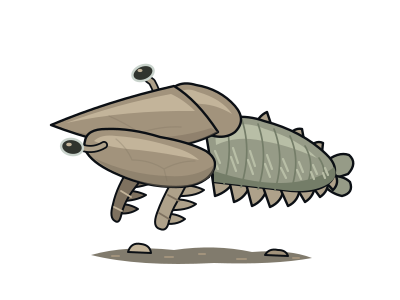
- CambrorasterA radiodont with a huge head shield shaped like a spaceship that raked the seafloor for food.