An extinct species
Anomalocaris †
Anomalocaris canadensis
One of the first big hunters in the sea, with two spiny grabbing arms
Lived about 510–505 million years ago.
You and the anomalocaris meet in the Two-sided animals branch, shown at about 580 million years ago (on 11 November, in a calendar from life's shared ancestor to today).
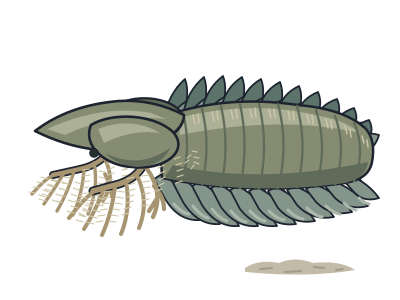
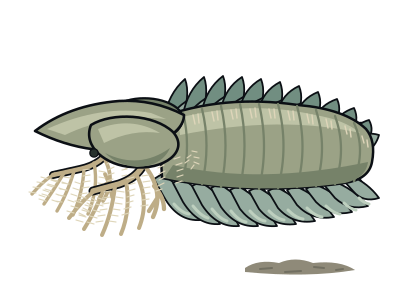
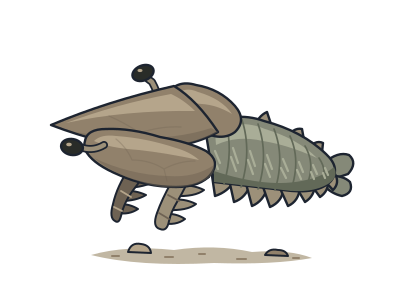
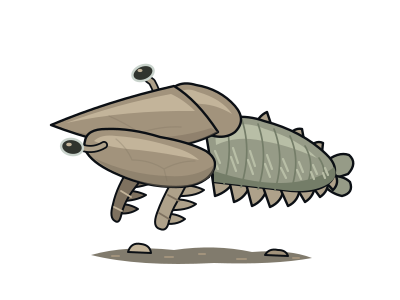
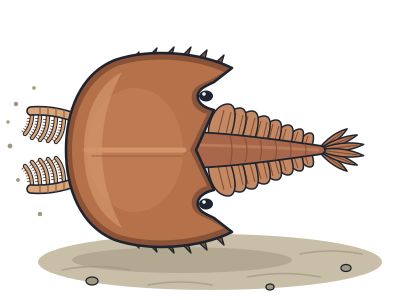
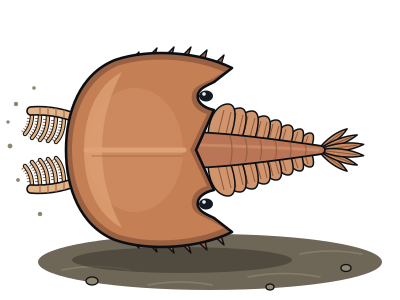
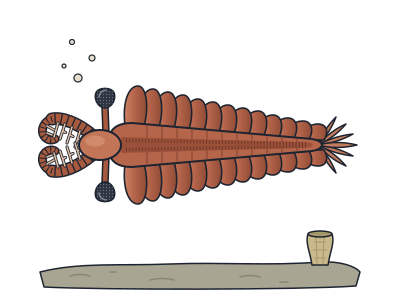
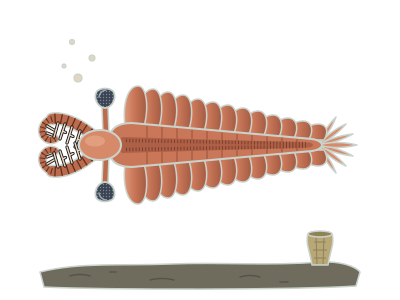
About 510 to 505 million years ago, long before the dinosaurs, this animal was one of the first big hunters in the sea. Large ones were probably about 40 to 60 centimetres long including the arms and tail fan, which is longer than a school ruler. At the front it had two curved, spiny arms for grabbing food, and it had two large eyes on stalks.
Its name means 'strange shrimp', but it was not a shrimp. It was a radiodont, part of an extinct group near the base of the family tree that today includes insects, spiders, crabs and millipedes. Radiodonts fed in very different ways. Aegirocassis, shown beside it, was a giant about 2 metres long that filtered food from the water.
Fossils from the Burgess Shale in Canada show its arms, a ring of hard plates around its mouth, 13 pairs of swimming flaps and a fan-shaped tail. A 2023 computer-modelling study suggested it was a fast swimmer that chased soft-bodied prey through open water. People once thought it crushed hard-shelled trilobites, but its arms were probably too weak for that.
Its arms were first described in 1892 and were mistaken for shrimp tails. In the 1980s, researchers showed that scattered pieces belonged to one creature. Later work found that a round mouth with four big plates really came from a relative. Its own mouth had three large plates.
Spines on spines
Each front arm usually had 14 segments. Every segment carried a pair of spines, and each of those spines had smaller spines along it, like a comb.
A long-lasting family
Radiodonts as a group lasted far longer than this species did. Some were still swimming in the seas about 400 million years ago, more than 100 million years after it.
Thousands of lenses
Fossil eyes from South Australia, thought to come from a related Australian species of Anomalocaris, were about 2 cm long. The best-preserved one had more than 16,000 tiny lenses. Modern dragonflies have up to about 28,000.