A species
Namib fog-basking beetle
Onymacris unguicularis
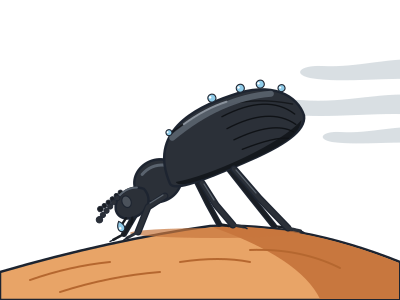
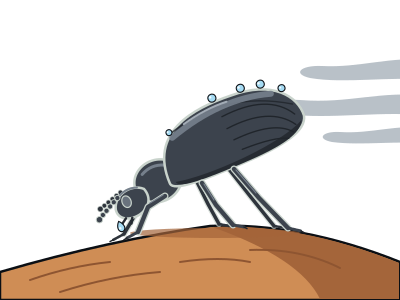
A desert beetle that drinks the fog by standing head-down on the dunes.
You and the namib fog-basking beetle meet in the Two-sided animals branch, shown at about 580 million years ago (on 11 November, in a calendar from life's shared ancestor to today).
Before dawn in the Namib Desert, this little black beetle climbs to the top of a sand dune. It is still so cold that the beetle is far below the temperature it works best at. Then it does something odd. It turns its back to the foggy wind, lifts its rear end and tips its head down towards the sand. Tiny fog droplets gather on its back, join up and trickle down to its mouth. Some beetles get little or no water, but others have been recorded drinking about a third of their own body weight in one go.
It is a darkling beetle. That puts it in the same family as the mealworm beetle, whose young are the familiar mealworms. About 200 kinds of beetle live in the Namib, but only this one and one close relative have been seen catching fog this way.
It is roughly 2 cm long and black all over. Its wing covers are joined together and it has no flying wings, so it cannot fly. It lives only on bare sand dunes in a desert where very little rain falls. By day it searches the sand for bits of dead plants and other scraps.
Two separate groups
There are two populations of this beetle, about 300 km apart. Flat plains with no dunes lie between them, and the beetles cannot cross. Scientists count them as two subspecies, one in the south and one in the north.
Not the bumpy beetle
Popular stories often show a fog-catching beetle with a bumpy back. That famous beetle is a different species. This one has a smooth back with fine grooves on the rear half.
Fog flips the switch
In laboratory tests of four Namib beetle species, this was the only one that took up the head-down pose. It needed fog to do it: cold air on its own was not enough.
Next to it on the tree
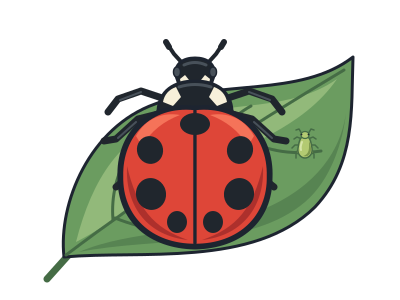
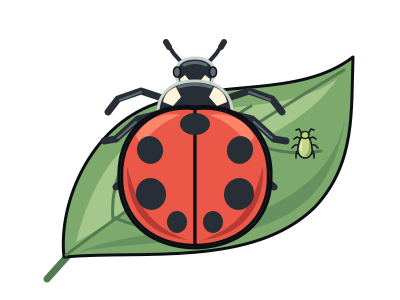
- Seven-spot ladybirdA gardener's friend that can eat thousands of aphids in its life.
- Ground, tiger and diving beetlesFast hunting beetles on land and in water, including the speediest runners for their size.
- Scarabs and stag beetlesHeavy beetles with fan-shaped antennae: dung rollers, chafers, horned giants.
- WeevilsBeetles with long snouts, one of the largest animal groups on Earth.
- Longhorn and leaf beetlesPlant-eating beetles: longhorns that bore into wood and colourful leaf-chewers.
- Fireflies and click beetlesGlowing beetles and their cousins that flip into the air with a loud click.
- Jewel beetlesMetallic beetles that shine like jewellery, used in art for centuries.
- Mealworm beetleIts larvae, mealworms, are fed to pets and birds and are now approved as human food.