An extinct species
Star-shaped Discoaster †
Discoaster
Tiny chalk stars that drifted in warm seas for over 55 million years
Lived about 58–1.9 million years ago.
You and the star-shaped discoaster meet in the Eukaryotes branch, shown at about 1.8 billion years ago (on 28 July, in a calendar from life's shared ancestor to today).
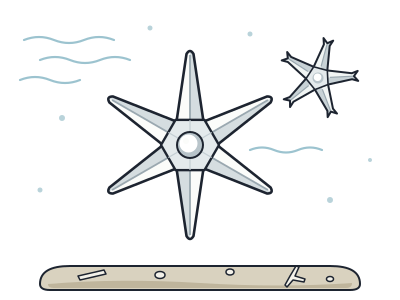
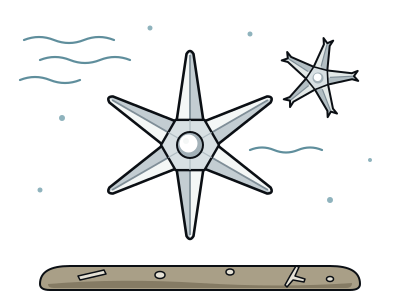
Picture a star made of chalk, so small that several could line up across the width of one human hair. Warm seas across the globe held vast numbers of them from about 58 to 1.9 million years ago. Then, within a million years of the start of the Ice Age, they vanished.
A single star was not a whole living thing. It was probably one chalky piece from the covering of a single-celled alga that drifted as plankton in warm oceans. These algae were relatives of living coccolithophores such as the Ehux coccolithophore, which still wraps itself in tiny chalk plates today. The stars were built differently, though. Each ray grew as its own separate crystal unit.
Fossils show that most younger stars had 5 or 6 straight rays. Some much older ones looked more like cog-wheels, with many short, curved rays. The soft cell has never been found. Scientists think these algae lived in the dim lower part of the sunlit sea, in calm water. That idea comes from where the fossils turn up and from comparison with a living alga.
Scientists think that as the seas cooled and the climate became more changeable, the stars became rarer. Then nutrient-rich water from deeper down rose towards the surface and squeezed out their home. Different kinds died out one after another. The very last ones probably survived in the Atlantic near the equator.
Clocks for geologists
Some kinds of these stars died out close to important dividing lines in Earth's timeline. Geologists look for their last appearance in layers of rock and seabed mud to help find those lines.
A crowded group
About 100 species have been named, and they were most common between about 23 and 5 million years ago.
Fancy tips
Some kinds had forked or knobbed tips on their rays, and some had little bars joining one ray to the next.
Next to it on the tree
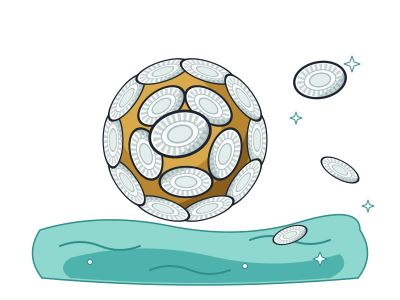
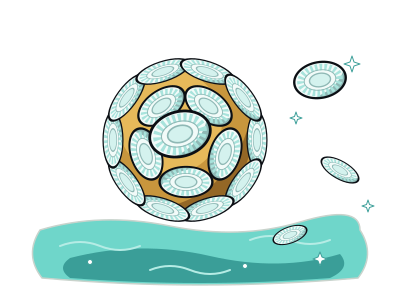
- Ehux coccolithophoreIts blooms turn whole seas milky turquoise in pictures taken from space.
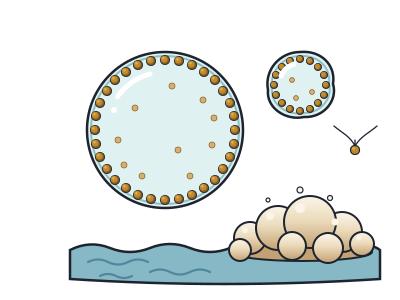
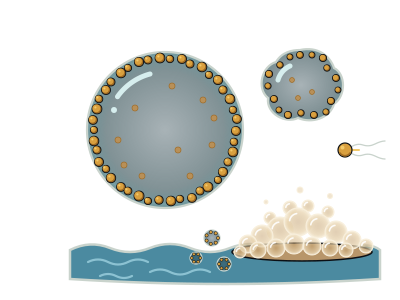
- Sea-foam algaIts jelly-like colonies whip up the thick foam that piles onto North Sea beaches.
- Pentagon coccolithophoreWears five-sided chalk plates and holds a nitrogen-fixing partner that became part of the cell.
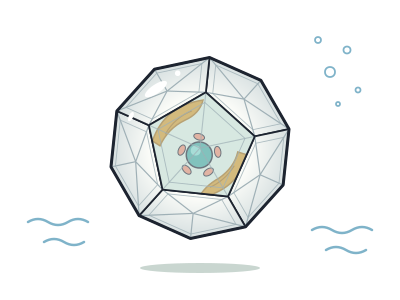
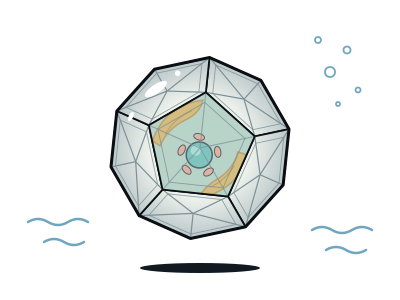
- Chalk-age coccolithThe most common chalk plate of the dinosaur seas, built into cliffs and limestone.