A group of living things
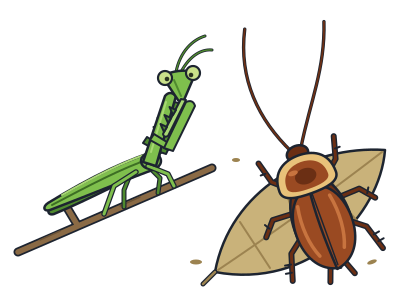
Cockroaches, termites and mantises
Dictyoptera
Termites are social cockroaches, and mantises are their cousins.
This branch is shown at about 300 million years ago; its age is a rough estimate.
You and cockroaches, termites and mantises meet in the Two-sided animals branch, shown at about 580 million years ago (on 11 November, in a calendar from life's shared ancestor to today).
Termites look like small, pale ants, but they are really cockroaches that took up life in huge colonies. In 2007, scientists compared genes from 107 species of termites, cockroaches and mantises. The termites landed right inside the cockroach family tree. In 2018 a major insect society made it official and put termites inside the cockroach group.
The termites' closest roach relatives eat wood. Some live in the Appalachian Mountains of the USA. A male and female chew tunnels in rotting logs and raise their young there, a little like a tiny termite family. Back in 1934, scientists noticed that these roaches and termites carry the same kinds of gut microbes, which help them digest wood. That was an early clue that they are related.
Mantises are the cousins in this family. The clearest link between mantises and cockroaches is the egg case. A female releases a frothy liquid with her eggs, and it hardens into a protective case. Mantis cases feel like polystyrene foam, while roach cases are usually more leathery. Most termites have lost the egg case altogether.
There are more than 2,400 known kinds of mantis. They look fierce, but they have no venom and are harmless to people. Females eat their mates far less often than many people think.
"Killing my own order"
After the 2007 study, termite expert Paul Eggleton joked that he was guilty of killing his own order, because termites no longer counted as a separate order of insects.
An ear on the chest
Many mantises have a single ear on the underside of the chest, between the legs. It picks up the high-pitched calls of bats, which helps a flying mantis dodge them in mid-air.
Bird hunters
Researchers have recorded 147 cases of mantises catching small birds, in 13 countries. Most of the birds were hummingbirds.
Inside cockroaches, termites and mantises
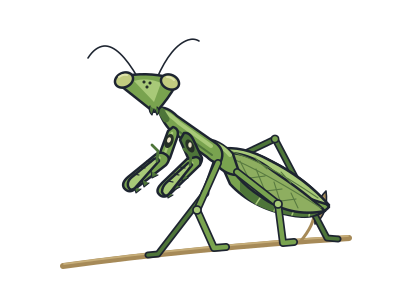
- European mantisAn ambush hunter that can turn its head to look over its shoulder.
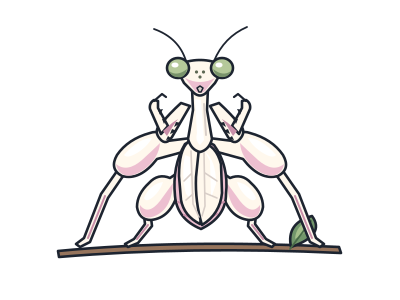
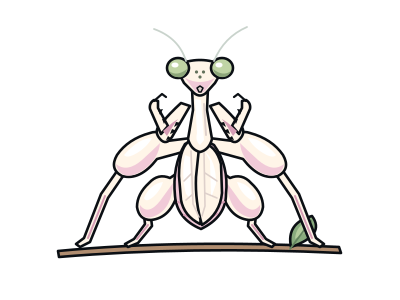
- Orchid mantisLooks like a pink flower and catches the insects that come to it.
- Chinese mantisA large mantis sold to gardeners, now common in North America after arriving in 1896.
- Devil's flower mantisOne of the largest mantises, flashing red, white and blue forelegs when threatened.
- Ghost mantisA small mantis that looks like a crumpled dead leaf.
- Dead leaf mantisIts wide body shield and wings make it look like a dry brown leaf.
- Cockroaches and termitesTermites are cockroaches that went social; their closest kin are wood-eating roaches.
Next to it on the tree
- Coal-forest roachoidA cockroach-like insect of the coal swamps, rebuilt in 3D from a fossil scan.
- ClatrotitanA giant Triassic cricket relative whose wings had sound-making patches.
- SalmonflyA giant stonefly whose mass hatch on western rivers is a famous fly-fishing event.
- GladiatorIts whole order was named in 2002 from museum and amber specimens, then found alive in Namibia.
- WebspinnerSpins silk from its front feet and lives in silk tunnels it can run along backwards.
- Grasshoppers and cricketsJumpers with big back legs that sing by rubbing wings or legs together.
- Stick and leaf insectsMasters of disguise that look like twigs or leaves, and many females need no males.
- EarwigsInsects with tail pincers and fan-like back wings folded up like origami.