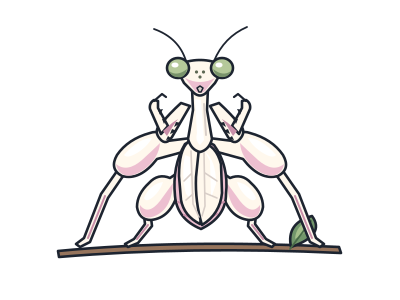
A species
Orchid mantis
Hymenopus coronatus
A flower-like hunter that draws insects in.
You and the orchid mantis meet in the Two-sided animals branch, shown at about 580 million years ago (on 11 November, in a calendar from life's shared ancestor to today).
The orchid mantis looks like a pink-and-white flower, but it catches the insects that come to visit. It belongs to the same mantis group as the European mantis. More surprisingly, both share a wider branch of the insect family tree with cockroaches and termites.
Instead of simply hiding in a bloom, this hunter can act as the attraction itself. Field experiments showed that flower-visiting insects approached the mantis, which caught them as prey. Calculations based on bee-and-wasp colour vision suggested that these insects could not tell its colour apart from those of local flowers.
It lives in tropical forests in Southeast Asia, including Malaysia and Indonesia. Looking flower-like does not tie it to one special plant: it lives among branches and other plant growth rather than depending on orchids.
Daytime hunter
Orchid mantises are active during the day.
Not one shade
Their colours vary between individuals and as they grow. They are not all equally pink.
Different growing schedules
In one life-history study, males reached adulthood earlier, while females lived longer.
Next to it on the tree
- European mantisAn ambush hunter that can turn its head to look over its shoulder.
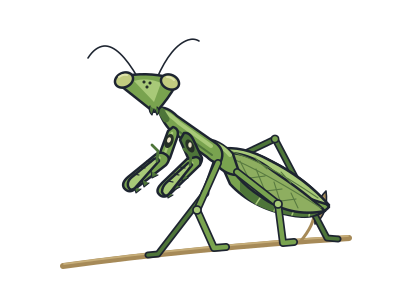
- Chinese mantisA large mantis sold to gardeners, now common in North America after arriving in 1896.
- Devil's flower mantisOne of the largest mantises, flashing red, white and blue forelegs when threatened.
- Ghost mantisA small mantis that looks like a crumpled dead leaf.
- Dead leaf mantisIts wide body shield and wings make it look like a dry brown leaf.
- Cockroaches and termitesTermites are cockroaches that went social; their closest kin are wood-eating roaches.