A species
Desert hairy scorpion
Hadrurus arizonensis
North America's biggest scorpion feels for its dinner through the sand.
You and the desert hairy scorpion meet in the Two-sided animals branch, shown at about 580 million years ago (on 11 November, in a calendar from life's shared ancestor to today).
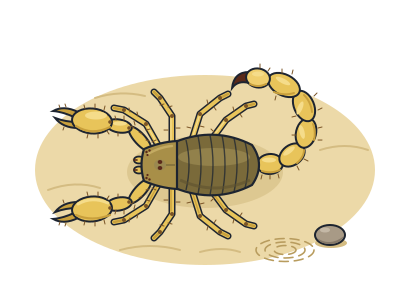
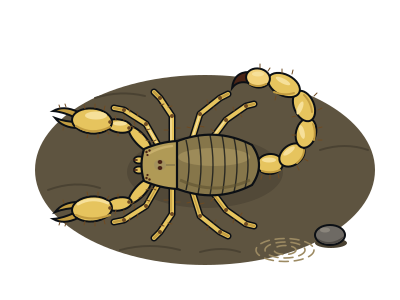
This is the biggest scorpion in North America. It usually grows about 10 to 15 centimetres long, roughly the length of an adult's hand. Yet it weighs only about as much as one or two sugar cubes. Its pincers, legs and tail are sandy straw-yellow, and its back is darker.
It's named for the fine brown hairs on its pincers, legs and tail. They don't keep it warm. They are sense organs that pick up tiny vibrations in the ground, so the scorpion can find prey in the dark. Sensors on its legs and a pair of comb-like organs on its underside help too.
By day it hides in burrows dug into sandy or gravelly desert ground, sometimes more than 2 metres deep. At night it sits and waits. Then it grabs insects, spiders and sometimes small lizards with its big claws.
Scorpions are not insects. They have eight walking legs and belong with spiders and their kin. On the tree it sits beside the emperor scorpion of West Africa, which is bigger still but belongs to a different scorpion family.
Babies ride on Mum
Mothers give birth to live young instead of laying eggs. The babies ride on their mother's back for a week or more before heading off on their own.
Big but not so bad
Despite its size, its venom is fairly weak. A sting usually feels like a honeybee sting and isn't deadly to people, though someone with allergies can react badly.
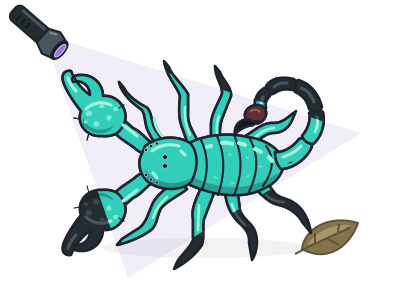
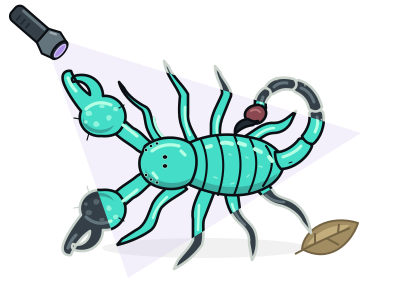
Glows in UV light
Under ultraviolet light its shell glows blue-green, as nearly all scorpions do. Nobody knows for sure why. One idea is that it helps the scorpion sense dim light with its whole body.