A species
Coleochaete
Coleochaete scutata
A tiny green disc on pond plants that botanists once thought pointed the way to land plants.
You and the coleochaete meet in the Eukaryotes branch, shown at about 1.8 billion years ago (on 28 July, in a calendar from life's shared ancestor to today).
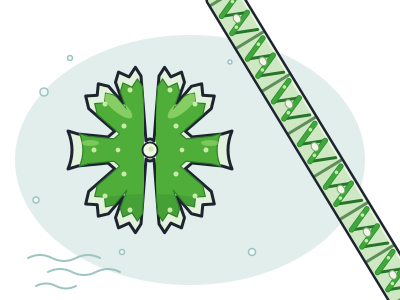
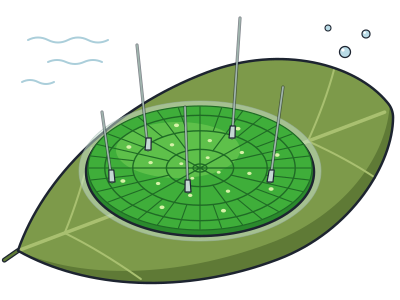
Look closely at the stem of a pond weed and you may find a tiny bright-green spot. Under a microscope it turns out to be a neat, round disc, only one cell thick, pressed flat like a dinner plate. This green alga lives in fresh water around the world, usually on water plants, but also on stones.
For a long time, botanists saw it as one of the algae most likely to be the closest relative of land plants. It is easy to see why. Its cells are linked by tiny channels, much like the cells of land plants. It also keeps its fertilised egg on the parent, where neighbouring cells wrap around it and seem to feed it, a bit like a plant nourishing its embryo.
But it is a cousin of land plants, not their ancestor. Studies that compare whole genomes now point to the desmids and pond silk as the closest living algal relatives of land plants, perhaps together with this disc-shaped alga. And unlike a land plant, its fertilised egg never grows into a new body. Instead it splits into about 8 to 32 tiny swimming cells, and each one starts a new disc.
Extra-long bristles
Some cells grow a thin bristle in a sheath that can be more than 100 times as long as a cell is wide.
One sperm per organ
It has a large egg that stays put and small sperm that swim. Each sperm-making organ makes just one sperm.
An old rival
In the older view, its main rival for the title of land plants' closest algal relative was the stoneworts.