A species
Stonewort
Chara vulgaris
A pond alga that looks like a tiny horsetail and crusts itself in lime.
You and the stonewort meet in the Eukaryotes branch, shown at about 1.8 billion years ago (on 28 July, in a calendar from life's shared ancestor to today).
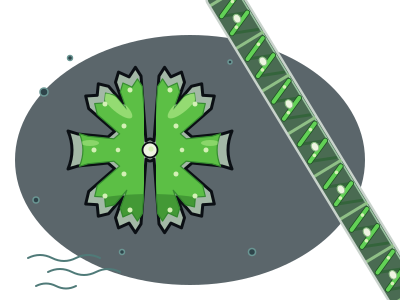
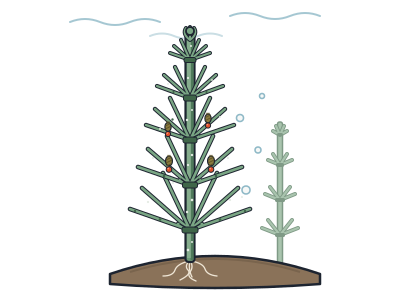
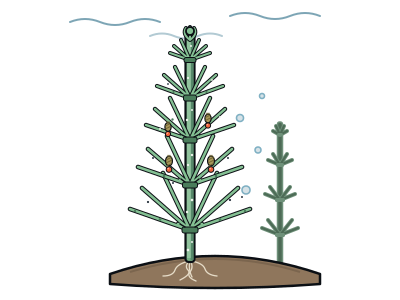
Look into a clear, shallow pond and you might spot what seems to be a tiny horsetail growing underwater. It is not a horsetail, or any kind of land plant. It is a green alga. Its thin stem is split into joints, and a ring of small branches grows from each joint, stacked in tiers like a bottlebrush. It can grow up to about 50 cm long, about as long as a child's arm.
The name comes from the 'stone' it makes. A crust of lime builds up on its surface from the limey water it lives in. This makes it feel rough and gritty and often gives it a frosted, greyish-green look.
Stoneworts belong to the same branch of the tree as land plants. Because they look so complex and plant-like, scientists long thought they were the closest living relatives of land plants. But most large gene studies now find that simpler algae, including Spirogyra, are closer still. A plant-like shape does not always mean the closest family tie.
Stonewort has no true roots. Thin threads hold it in the mud, and it takes in nutrients through its surface. Many stoneworts are harmed by pollution from fertilisers, so they are often a sign of clean water. Common stonewort is tougher than most and can cope with some of this pollution. In clear lakes stoneworts can carpet large areas and feed diving ducks.
Both sexes in one
A single common stonewort carries both male and female parts. The male parts are tiny orange-red balls, and the female parts sit right beside them, each holding one egg.
Waiting out hard times
After an egg is fertilised, it becomes a tough resting spore. The spore can survive bad conditions and sprout when things improve, which helps stonewort live in pools that sometimes dry out.
A smelly nickname
Stoneworts like this one are also called 'muskgrass' or 'skunkweed' because of their strong smell. Some people say it smells like rotten eggs, and others say it smells like onions.