A species
Desmid
Micrasterias rotata
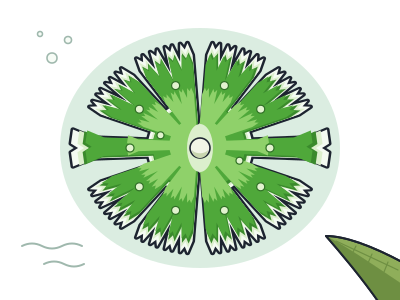
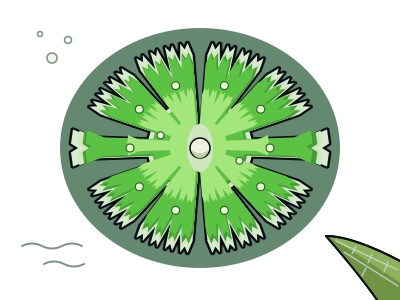
A single cell shaped like a green snowflake, from the algae that are land plants' closest living relatives.
You and the desmid meet in the Eukaryotes branch, shown at about 1.8 billion years ago (on 28 July, in a calendar from life's shared ancestor to today).
Picture a green snowflake about 0.2 to 0.4 millimetres across, roughly the width of a few human hairs side by side. The whole lacy shape is just one cell. A narrow waist runs across the middle, splitting it into two halves that are mirror images of each other. Each half has five main lobes. The side lobes split again into smaller points, which gives the cell its deeply cut, frilly edge.
It is not an animal. It is a green alga that makes its food from sunlight, just like a plant. In fact, its group, the conjugating green algae, also includes the pond silk Spirogyra and is the sister group of land plants. So this tiny snowflake is more closely related to trees, grass and flowers than most other algae are.
It usually reproduces by splitting in two at the waist. Each old half then grows a brand-new matching half, with its lobes pushing outwards. In lab studies of a close relative, this takes about five hours. That means one half of each cell is older than the other, even though they look like twins.
It lives only in fresh water, mainly in acidic, nutrient-poor peat bogs and moorland pools. It is one of the most common species in its group of snowflake desmids.
It moves by oozing jelly
It has no tail for swimming. Instead, it pushes out a jelly-like layer through tiny pores in its wall, which lets it creep slowly in one direction.
A living pollution alarm
Large snowflake desmids like this one are extremely sensitive to heavy metals and other pollution, and they vanish from water with too many nutrients. So scientists can use them to check how healthy bog water is.
A name that means 'bond'
The word 'desmid' comes from the Greek 'desmos', meaning bond or chain.