A species
Red abalone
Haliotis rufescens
A sea snail with an ear-shaped shell lined with rainbow mother-of-pearl.
You and the red abalone meet in the Two-sided animals branch, shown at about 580 million years ago (on 11 November, in a calendar from life's shared ancestor to today).
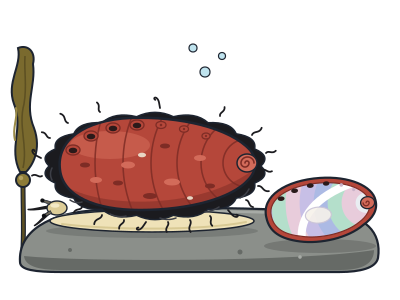
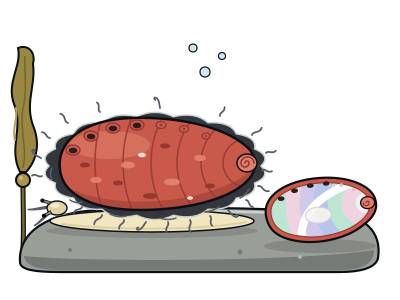
From the outside it looks like a flat, lumpy, brick-red rock. Turn it over and the inside shines with rainbow mother-of-pearl in silver, pink, green, blue and purple. This is a sea snail. That makes it a relative of the garden snail and of the limpets that cling to rocky shores. Its low, open spiral shell looks like a human ear, so abalone are also called 'ear shells'.
It is the largest abalone in the world. Its shell can grow up to about 31 cm long, about as long as a school ruler. It lives on rocky coasts and in kelp forests from Canada down to Mexico. A huge muscular foot grips the rock like a suction cup, and it grazes on drifting and attached kelp.
The shell is very tough. It is built from tightly packed layers of mineral held together with protein. When something pushes hard on it, the layers slide instead of shattering. Scientists study it for ideas such as better body armour.
Today it is in trouble. After a marine heatwave in 2016, many sea stars died, purple sea urchins boomed, and many of the kelp forests it feeds on were lost. In 2022 it was listed as Critically Endangered.
You are what you eat
The red colour of the shell comes from a pigment much like one found in red seaweeds. Abalone that eat brown algae grow green or blue-green shell instead.
Holes with a job
A row of usually 3 or 4 raised holes runs along one edge of the shell. The abalone pushes used water out through them and releases its eggs or sperm through them too.
A Californian name
The word 'abalone' came into English through Spanish from 'aulón', a word in Rumsen. Rumsen is a language of Indigenous people from the Monterey area of California.
Next to it on the tree
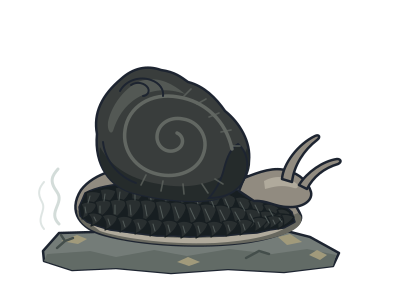
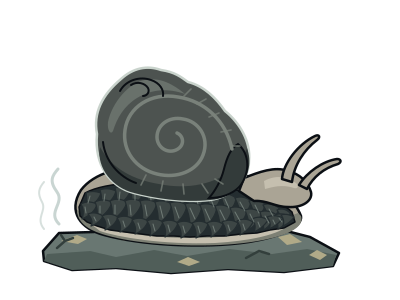
- Scaly-foot snailA deep-sea vent snail armoured with iron scales.
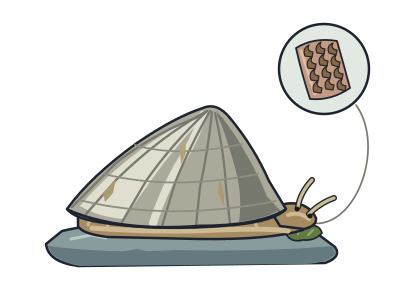
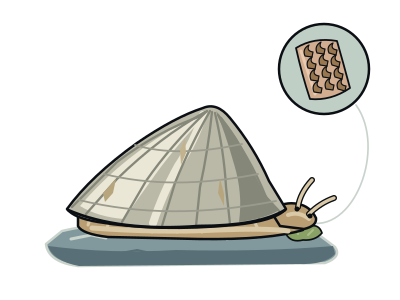
- Common limpetIts teeth are the strongest natural material known.
- Sea snails and whelksThe biggest group of snails, including most seashells you find on a beach.
- Slugs, land snails and sea slugsSnails that often lost or shrank their shell, and some that moved onto land and breathe air.