A species
Wheat stem rust
Puccinia graminis
The rusty orange fungus that has spoiled wheat harvests for thousands of years
You and the wheat stem rust meet in the Fungi and animals branch, shown at about 1.3 billion years ago (on 10 September, in a calendar from life's shared ancestor to today).
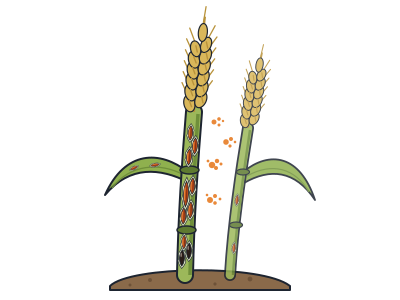
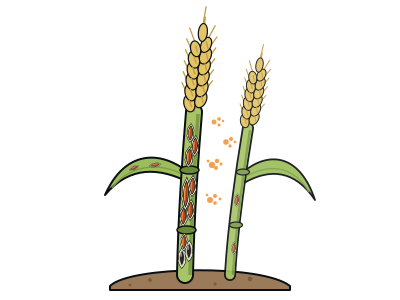
Look closely at a wheat stem in summer and you might find rows of rusty orange blisters. A fungus makes them, and it has been spoiling harvests for thousands of years. Every 25 April, the ancient Romans held a festival for a god linked to the reddish rust, to protect their grain fields. Burnt traces of the fungus have even been found on wheat husks in a storage jar in Israel that is about 3,300 years old.
Surprisingly, this fungus belongs to the same big group as mushrooms, but it never grows a mushroom. Instead, it lives as a web of microscopic threads inside the plant. It takes the wheat's food and breaks open the stem's outer skin, so the plant loses water. It also disrupts the plant's water pipes. The grain shrivels and weak stems can fall over. Late in the season, the orange streaks turn glossy black.
To finish its full life cycle, it needs two very different plants: a cereal such as wheat or barley, and a shrub called common barberry. From about the 1960s, new resistant wheat kept it largely under control. Then a new strain was found in Uganda and named Ug99 in 1999. It beat a resistance gene that had protected wheat for decades, and it has since spread to other countries.
An early ban
In 1660, the French city of Rouen passed a law against barberry bushes to protect wheat. This was long before scientists understood how the fungus moves between the two plants.
Five kinds of spore
Over its full life cycle, the fungus makes five different kinds of spore.
Carried by the wind
Wind can carry its spores hundreds of kilometres. In rare cases they have travelled thousands of kilometres, such as from South Africa to Western Australia.