A species
Termite gut partner
Trichonympha agilis
The tiny gut partner that lets termites live on wood
You and the termite gut partner meet in the Eukaryotes branch, shown at about 1.8 billion years ago (on 28 July, in a calendar from life's shared ancestor to today).
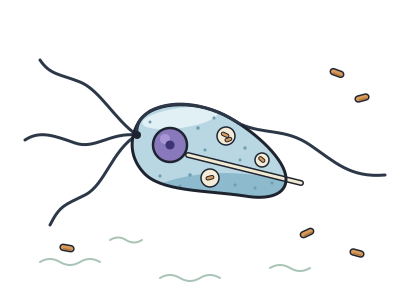
A termite can chew wood all day and still starve. Many termites can't break down enough wood by themselves. Instead, they rely on tiny single-celled partners living in their gut, and this is one of them. It breaks down cellulose, the tough material in wood, into sugars. It then turns those sugars into the termite's main fuel, giving off hydrogen gas along the way.
In the 1920s, a scientist named Lemuel Cleveland removed all the single-celled partners from termites' guts. On a diet of only wood, the termites starved, even though they still had their gut bacteria. Giving the partners back saved them.
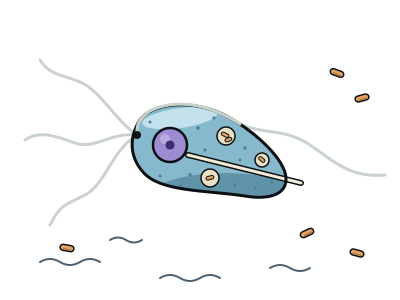
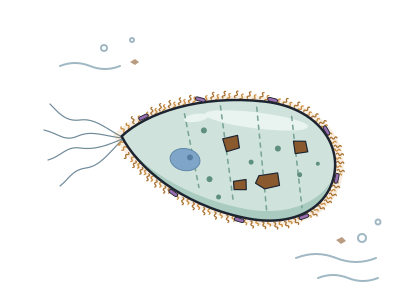
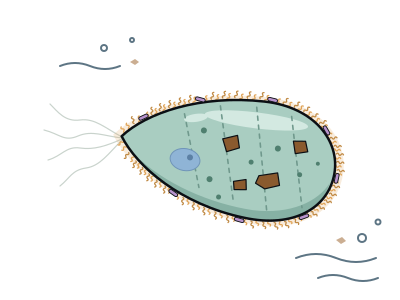
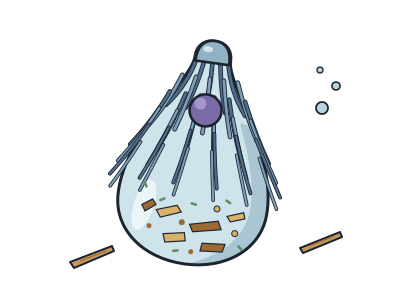
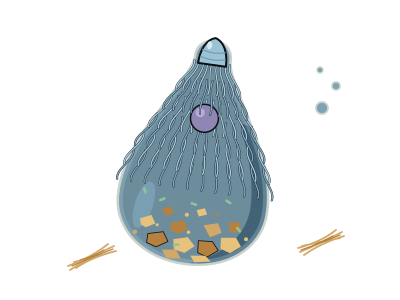
Each partner is a single cell about a tenth of a millimetre long, roughly the thickness of a human hair. It is shaped like a bell and covered in thousands of flagella that beat in waves. It can't survive outside a termite. It even dies each time its host moults, so termites pick up new partners by sipping gut fluid from their nestmates.
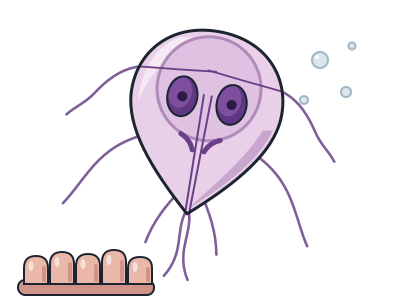
On the tree it sits beside Giardia, a gut germ that can make people sick. Both belong to a group of single cells that avoid oxygen, but they are only distant relatives. This one does not infect people.
A city within a city
Each cell carries its own bacterial partners. About 4,000 bacteria live inside it, and about 1,800 more sit in deep pockets in its surface. These bacteria help keep its digestion going and make nutrients.
Shared with cockroaches
Wood-eating cockroaches, the closest relatives of termites, carry close cousins of this gut partner. This suggests the partnership began in an ancestor of both insects.
Power without oxygen
Most cells with a nucleus use mitochondria to get energy. This one has stripped-down versions called hydrogenosomes instead. They work without oxygen and give off hydrogen gas.