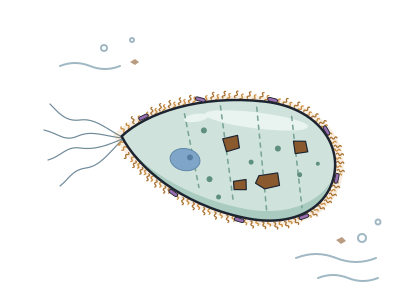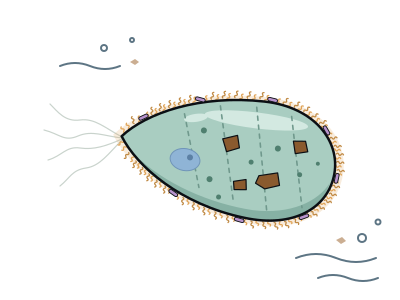
A species
Giardia
Giardia intestinalis
A tiny gut parasite with a face that seems to stare back at you
You and the giardia meet in the Eukaryotes branch, shown at about 1.8 billion years ago (on 28 July, in a calendar from life's shared ancestor to today).
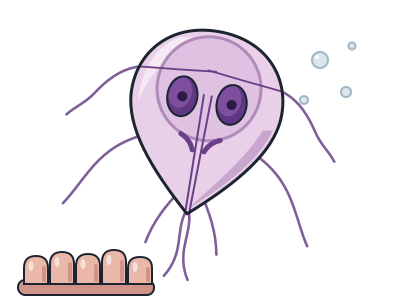
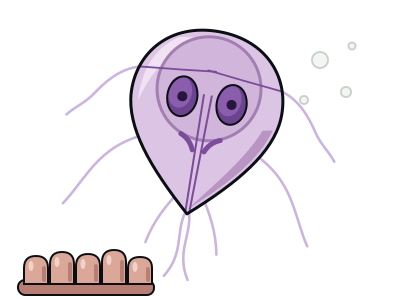
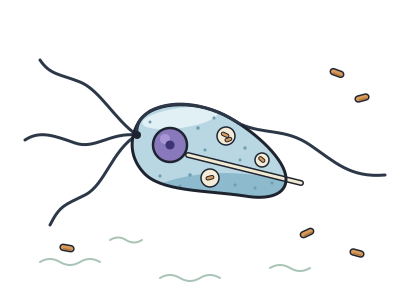
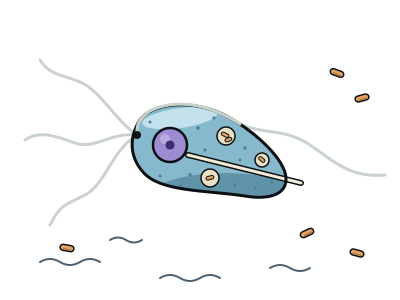
Look at it under a microscope and it seems to stare back. This single cell is shaped like a pear sliced in half. When it is stained, its two nuclei look like a pair of eyes, and two stiff rods below them look like a mouth. These are real parts of the cell, but the 'face' is just a lucky pattern. It has no real eyes at all.
It is far too small to see without a microscope, about 15 micrometres long. Roughly 50 to 100 of them would fit across a single millimetre. It lives in the small intestine of people and many other animals and grips the gut lining with a disc on its underside. Eight whip-like tails, in four pairs, push it along. It can make people sick, and it spreads as tough, oval cysts that survive outside the body.
Its family is surprising. It belongs to a group of single-celled swimmers that live with little or no oxygen. The same group includes the tiny tail-waving cells that help termites break down wood. Scientists once thought it was a 'primitive' cell from before mitochondria, the cell's power stations, evolved. Then, in 2003, scientists found tiny, shrunken leftovers of mitochondria inside it. Its ancestors had full mitochondria, and over time these shrank to tiny remnants.
Named twice over
Its names honour two scientists: Czech doctor Vilém Lambl, who described it in 1859, and French zoologist Alfred Giard.
Hard to wash away
Its cysts can last for weeks to months in cold water, and ordinary chlorine water treatment often fails to kill them.
A worldwide visitor
Scientists think it infects more than 280 million people around the world each year, and young children catch it most often.
Next to it on the tree
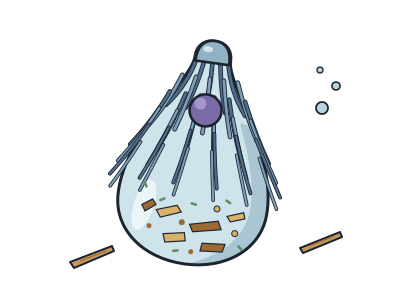
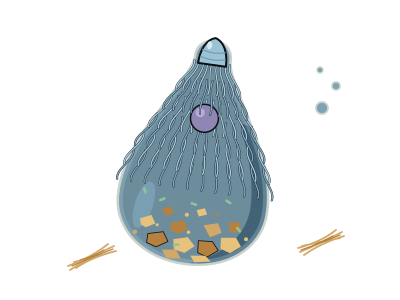
- Termite gut partnerLives inside termites and helps them digest wood; without it, termites starve on a full stomach.
- MonocercomonoidesThe first complex cell found with no mitochondria at all, living in a chinchilla gut.
- MixotrichaA termite gut cell that gets about by riding on thousands of wriggling bacteria.