A species
Monocercomonoides
Monocercomonoides exilis
The complex cell that threw away its powerhouses
You and the monocercomonoides meet in the Eukaryotes branch, shown at about 1.8 billion years ago (on 28 July, in a calendar from life's shared ancestor to today).
Nearly all complex cells, including the ones in your body, contain mitochondria. These are tiny parts that help power the cell. In 2016, Czech and Canadian scientists reported a single-celled creature from a chinchilla's gut that has none at all. It was the first complex-celled living thing known to manage completely without them. One of the researchers called it a big surprise, because having mitochondria was thought to be part of what makes a complex cell.
It is not a leftover from a time before mitochondria existed. Its ancestors had them, and its line lost them later. Its relatives on the tree include Giardia, a gut parasite, and flagellates that live in termite guts. Some related parasites keep shrunken mitochondria that do just one job: building iron-sulfur clusters, small parts that many proteins need.
This cell does that job another way. It uses a toolkit whose genes came from bacteria. As one scientist put it, it 'stole or borrowed' them. It lives in the gut, where food is plentiful but oxygen is scarce, and gets its energy mainly by breaking down sugar. It eats bacteria and probably does no harm to the chinchillas and related rodents it lives in.
Still a full complex cell
Apart from the missing mitochondria, it has the usual machinery of a complex cell. This includes an inner skeleton, tools for repairing its DNA and systems for recycling worn-out parts. Its genetic instructions run to roughly 75 to 82 million DNA letters, with about 17,000 to 18,000 genes.
A stiff inner rod
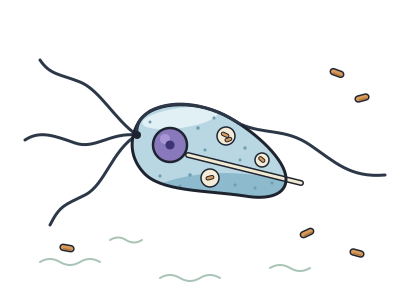
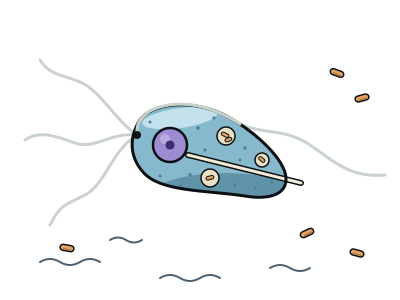
A single long, thin rod made of tiny tubes starts near the nucleus at the front of the cell and runs back through the body, helping to support it.
Other parts missing too
It also lacks the small compartments called peroxisomes. Scientists also cannot see the usual stack of flattened sacs that sorts and packages proteins. As it breaks down its food, it gives off hydrogen gas.
Next to it on the tree
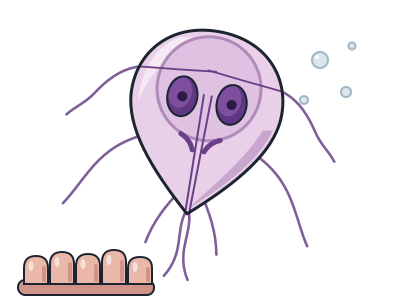
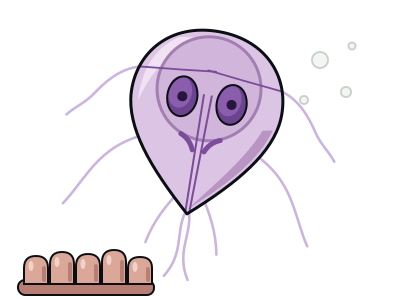
- GiardiaA pear-shaped gut parasite whose two nuclei look like eyes staring up from a microscope.
- Termite gut partnerLives inside termites and helps them digest wood; without it, termites starve on a full stomach.
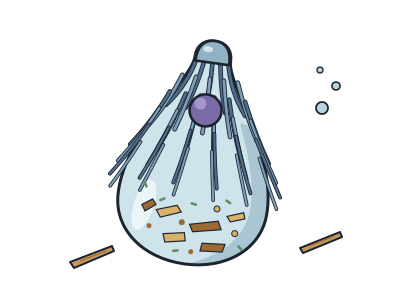
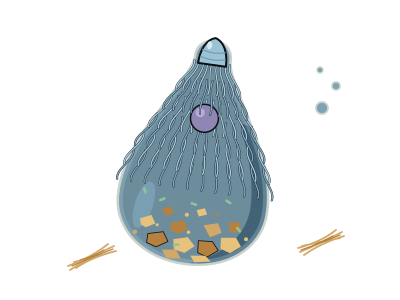
- MixotrichaA termite gut cell that gets about by riding on thousands of wriggling bacteria.