A species
Hot-spring bacterium
Thermus aquaticus
A tiny hot-spring microbe whose heat-proof enzyme made modern DNA testing possible.
You and the hot-spring bacterium meet in the All life branch, shown at about 4.2 billion years ago (on 1 January, in a calendar from life's shared ancestor to today).
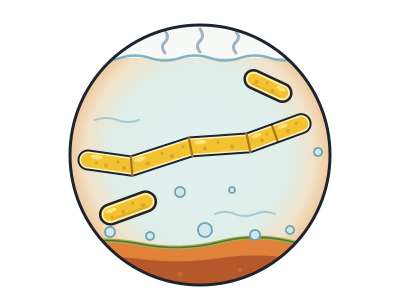
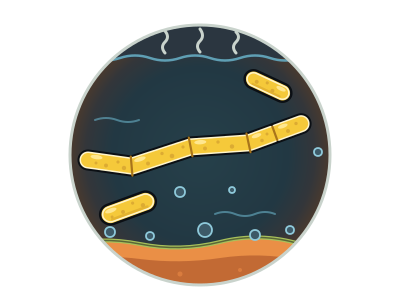
In 1966, the scientist Thomas Brock and his student Hudson Freeze took a sample from a hot spring in Yellowstone National Park, USA. It held a tiny bacterium that lives in water at about 70 °C, far too hot to touch. At the time, many scientists thought bacteria could not live in water that hot, so it was a real surprise.
Its biggest fame came later. The bacterium has an enzyme that copies DNA, and this enzyme doesn't fall apart in heat. That turned out to matter for PCR, a method invented in 1983 that makes billions of copies of a piece of DNA. PCR heats DNA to nearly boiling over and over again. The older enzyme was destroyed every time, so fresh enzyme had to be added each round. The hot-spring enzyme survives the heat, so a machine can run the whole process in one closed tube. Today PCR is used in medical tests, crime investigations, the study of ancient DNA and COVID-19 tests.
Shown beside it on the tree is Conan the bacterium. The two are distant relatives in their own small branch of bacteria, but they went opposite ways. Bacteria of the hot-spring kind love heat but cope fairly poorly with radiation and drying out. Conan lives at ordinary temperatures and is extremely tough against both.
Molecule of the Year
In 1989, the science journal Science named its heat-proof enzyme its first ever 'Molecule of the Year'.
Not a perfect copier
Its enzyme can't check its own work, so it makes the odd copying mistake. Early tests found about one mistake in every 9,000 DNA letters.
No money for the park
The rights to PCR were sold for 300 million US dollars, but Yellowstone National Park got no money from the original discovery.