A species
Synura
Synura petersenii
A tumbling golden ball in glassy armour that can make tap water taste of fish
You and the synura meet in the Eukaryotes branch, shown at about 1.8 billion years ago (on 28 July, in a calendar from life's shared ancestor to today).
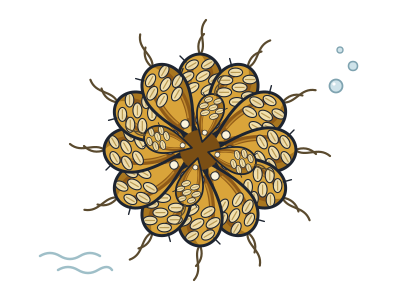
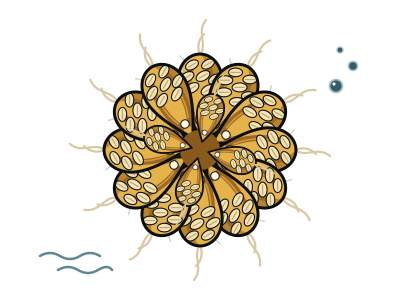
This tiny golden ball can make drinking water taste of fish. When lots of colonies grow in a lake or reservoir, they release chemicals that give the water an unpleasant fishy smell or taste. Some people notice cucumber instead.
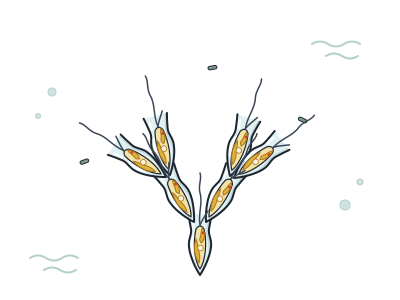
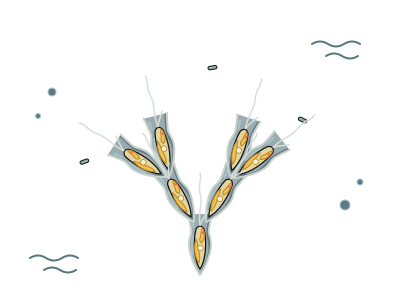
Each ball is a colony. Many cells are joined at their narrow back ends in the middle and point outwards, like the segments of a peeled orange. A whole colony is thinner than a typical human hair. Each cell has a coat of tiny overlapping scales made of silica, the material glass is made from. A large cell can carry about 90 of them. The scales sit in neat spiral rows, a bit like roof tiles.
Each cell has two whip-like hairs. Working together, they make the colony roll and tumble through the water. Its colour is golden-brown, but it is not a plant. It belongs to the golden algae, which are part of the same big group as kelp and diatoms. So this speck is a relative of the great brown seaweeds of the sea.
A name about tails
The German microscope expert Christian Gottfried Ehrenberg named this group of algae in 1834. The name Synura comes from Greek words meaning 'together' and 'tail'.
A museum crowd
In January 1922, Synura algae gave New York City's tap water a fishy or cucumber-like taste. The American Museum of Natural History put a glass model of a colony on show. On one Sunday, about 15,000 visitors came instead of the usual 5,000.
Found far and wide
Synura algae are common in lakes, ponds and slow rivers from temperate areas to the tropics. They are much rarer in the Arctic and subarctic.