A species
Common sea fan
Gorgonia ventalina
A purple living net that grows across the current and catches its dinner.
You and the common sea fan meet in the Animals branch, shown at about 700 million years ago (on 1 November, in a calendar from life's shared ancestor to today).
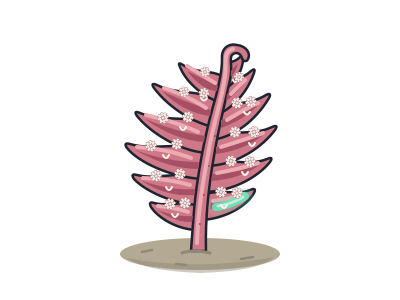
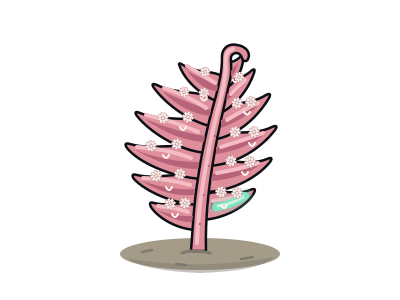
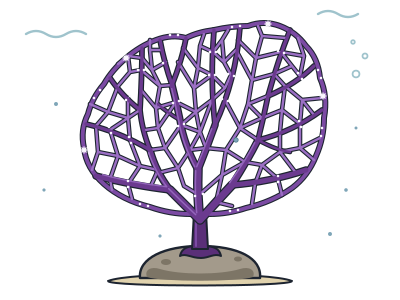
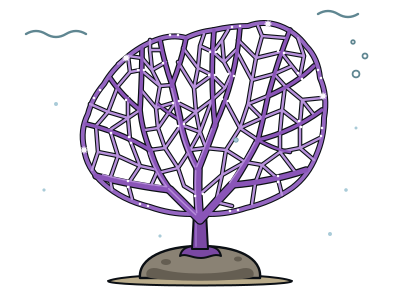
Picture a flat purple net standing upright on a shallow reef. It grows broadside to the waves and currents, so as much water as possible flows straight through its holes. Tiny drifting animals in that water get caught and eaten. It looks like a plant, but it is actually a colony of many tiny animals called polyps, all joined together.
The polyps sit in small pores in two rows along the edges of the branches. When a polyp opens, it spreads eight feathery tentacles, like a tiny white flower, to grab the plankton drifting past. Tiny algae living inside the sea fan also use sunlight to make food and share some of it, just as they do for reef-building corals.
Unlike stony corals, the sea fan has a bendy skeleton made of a tough protein with some mineral mixed in. So it sways in the surge instead of snapping.
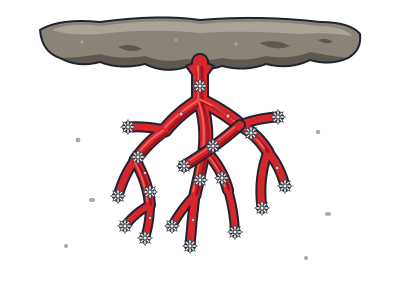
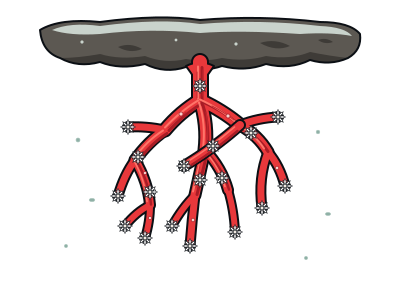
Its eight-tentacled polyps make it an octocoral. On the tree, its nearest neighbours are the phosphorescent sea pen and the precious red coral. Further back, the family links it to sea anemones and even jellyfish.
A disease swept through
From the mid-1990s, a fungal disease spread across the Caribbean. In the Florida Keys, more than half of all sea fan tissue was lost, and the biggest fans were hit hardest. The outbreak most likely faded because the sea fans became better at resisting it.
A slug that borrows its defences
Hard needles and nasty chemicals put most predators off. One sea slug eats the sea fan anyway and stores one of its chemicals to protect itself.
No sign of old age
There is no evidence that sea fans die of old age. Storms ripping them off the rock, or other living things growing over them, are what kill them. Broken-off pieces can even regrow into new fans.