An extinct group
Scyphocrinites sea lily †
Scyphocrinites
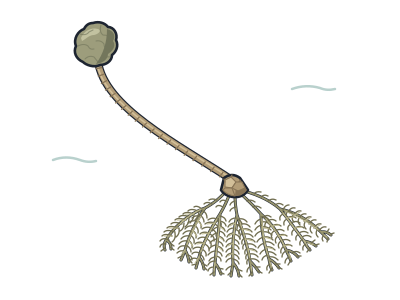
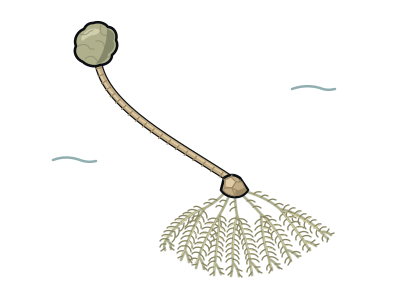
A sea lily whose built-in bulb may have been a float.
Lived about 423–413 million years ago.
You and scyphocrinites sea lily meet in the Starfish, sea squirts and us branch, shown at about 560 million years ago (on 13 November, in a calendar from life's shared ancestor to today).
This sea lily was thought to have floated beneath a gas-filled bulb, rather than standing on the seabed. Despite its flower-like shape, it was an animal, related to starfish, sea urchins and sea cucumbers. In that reconstruction, its long stem linked the bulb above to a small body and branching arms below.
It lived around 420 million years ago. Its arms would have gathered tiny food particles from passing seawater, rather than making food from sunlight as a plant did. The arms branched again and again. Together with the cup-like body, they formed a feathery crown. Its stem consisted of small skeletal discs stacked together, rather like a string of beads.
Fossils preserved skeletal parts of the arms, cup-like body, stem and chambered bulbs. These remains provided clues to its unusual shape, but did not prove that it floated. It belonged to an extinct branch of the sea-lily family, separate from the branch containing living sea lilies and feather stars. The name covered several species, not just one.
Its own built-in bulb
The bulb developed from branching attachment structures. It was part of the animal, not a separate shell it carried.
A clue to the age of rocks
Its wide distribution and short span in geological time helped researchers match the ages of rocks in different countries.
A skeleton that came apart
Like other sea lilies, it had a skeleton made from many mineral plates. These often scattered after death, making complete fossils unusual.
Next to it on the tree
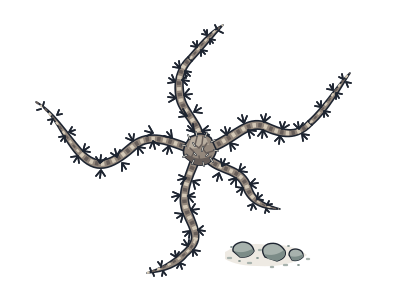
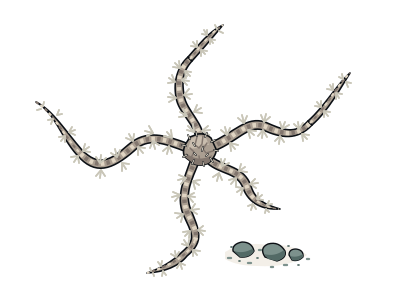
- Common brittle starWhip-thin arms that snap off to escape, then grow back; millions can carpet the sea floor.
- Sea lilies and feather starsFlower-like echinoderms that catch food with feathery arms; once they carpeted ancient seas.
- Sea starsStar-shaped hunters that can push their stomachs out to digest food outside the body.
- Sea urchins and sand dollarsEchinoderms with a rigid ball or disc of plates, covered in moving spines.
- Sea cucumbersSoft, sausage-shaped echinoderms that hoover the sea floor; in the deep sea they dominate.
- PentremitesA bud-shaped blastoid on a stalk, one of the commonest fossils in Carboniferous rocks of the US Midwest.