A species
Sargassum
Sargassum natans
A golden seaweed raft that names a sea and shelters baby turtles
You and the sargassum meet in the Eukaryotes branch, shown at about 1.8 billion years ago (on 28 July, in a calendar from life's shared ancestor to today).
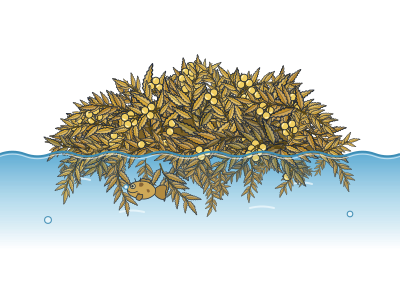
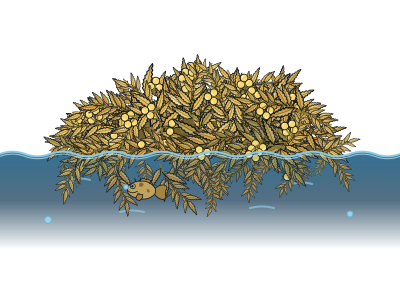
In the middle of the North Atlantic is a sea with no coastline. Four ocean currents mark its edges instead of land. It is called the Sargasso Sea, after this golden-brown seaweed. Clumps of it drift on the surface in long lines and mats, and baby sea turtles use them as floating nurseries.
After they hatch, young loggerhead turtles disappear out to sea, and for a long time no one knew where they went. In one study, scientists put small tags on young turtles and released them into mats off Florida, and the turtles stayed with the seaweed. The mats trap sunlight and warm the water around them, which probably helps the turtles grow.
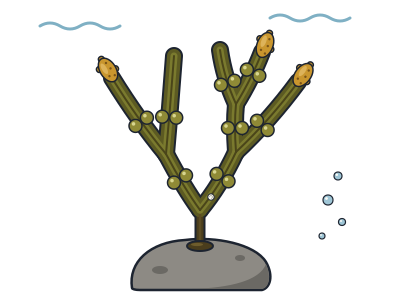
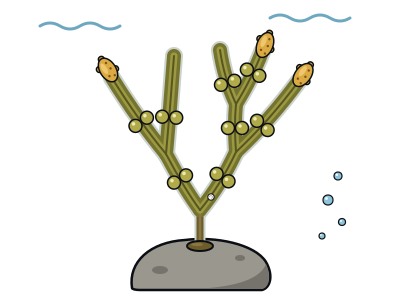
It may look like a plant, but it is a brown seaweed. It is related to giant kelp and bladderwrack, and it is closer kin to tiny diatoms and water moulds than to any tree or flower. There are more than 300 kinds of sargassum, and most grow fixed to rocks near the coast. This one and one close relative are the only kinds that float for their whole lives. They have no root-like grip at all. Small gas-filled floats that look like tiny berries keep the seaweed at the surface.
Grows by breaking
Floating sargassum makes more of itself by breaking into pieces, and each piece keeps growing. In good conditions it can double in size in about 9 to 13 days.
A crowded raft
More than 100 kinds of animals have been found living in sargassum mats. They come from more than 11 major animal groups, including fish and crabs.
Ocean birthplace
The Sargasso Sea is an important breeding area for threatened eels, white marlin, porbeagle sharks and dolphinfish.