A species
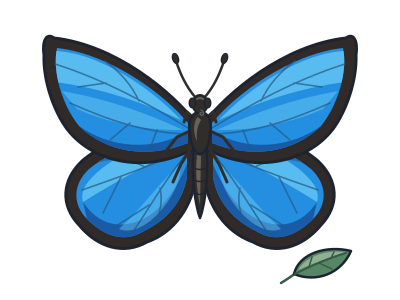
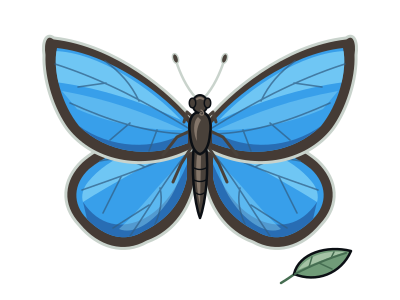
Blue morpho
Morpho menelaus
Brilliant blue, built from tiny wing structures.
You and the blue morpho meet in the Two-sided animals branch, shown at about 580 million years ago (on 11 November, in a calendar from life's shared ancestor to today).
The blue morpho’s brilliant colour comes from tiny structures that interact with light, not from blue pigment. Its wings carry overlapping scales. Lower scales have repeating tiny plates, beneath transparent covering scales. Light reflected from neighbouring structures can strengthen or cancel other reflections, making the blue stand out. Change your viewing angle, or the angle of the light, and the colour shifts. This changing appearance is called iridescence.
Those scales are also a family connection. Like the monarch butterfly and the moths beside it on the tree, this butterfly belongs to a group whose members share tiny wing scales. They also follow the same stages of life: egg, caterpillar, pupa and adult. The dazzling blue morpho and the silkworm moth belong to the same wider butterfly-and-moth group.
It lives in tropical American forests. The bright blue is only one side of its appearance: underneath, the wings are brown with eye-like spots. Closing the wings hides the blue and reveals these camouflaged surfaces. The spots are markings, not extra eyes.
Brown pigment too
Its wings contain brown pigment. Having blue made by tiny structures does not mean being pigment-free.
Not every morpho is blue
Some other morpho species have brown, orange or white wings instead of brilliant blue.
Colour that lasts
Colours made by tiny structures can stay vivid in preserved specimens even after pigment colours have faded.
Next to it on the tree
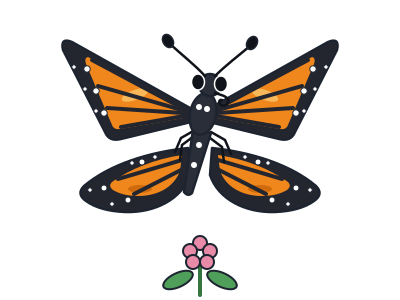
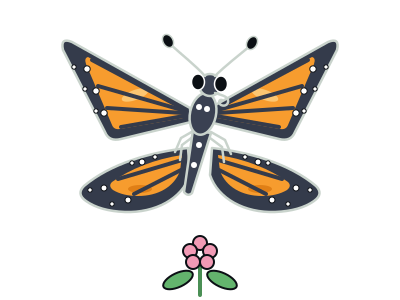
- Monarch butterflyFlies thousands of kilometres to a forest none of its parents ever saw.
- Painted ladyMigrates between Africa and Europe over several generations, a 12,000 km round trip.
- Peacock butterflyFlashes four big eyespots and hisses with its wings to scare off mice.
- Red admiralA black butterfly with red bands that drinks from rotting fruit in autumn.
- Glasswing butterflyIts wings are clear like glass, thanks to tiny bumps that stop reflections.
- Owl butterflyIts underwings show huge eyespots that may look like an owl's eye.
- Zebra longwingEats pollen to live for months and roosts in groups every night.