A species
Field hornwort
Anthoceros agrestis
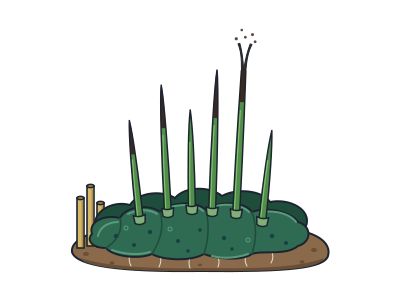
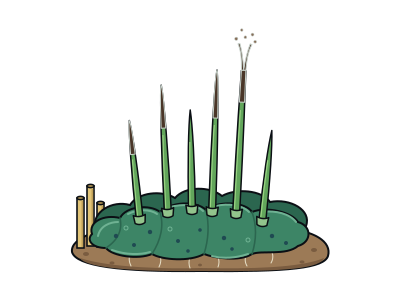
A fingernail-sized plant that grows green horns and keeps bacteria in its body.
You and the field hornwort meet in the Eukaryotes branch, shown at about 1.8 billion years ago (on 28 July, in a calendar from life's shared ancestor to today).
This tiny plant grows little green horns, and it shares its body with bacteria. Inside its flat green body are small pockets filled with slime. These pockets hold colonies of Nostoc, a bacterium that can make its own food from sunlight. In hornworts, chemicals from the plant coax nearby bacteria to glide in as moving threads. Once inside, they fix nitrogen. They take it from the air and turn it into a nutrient the plant can use to grow.
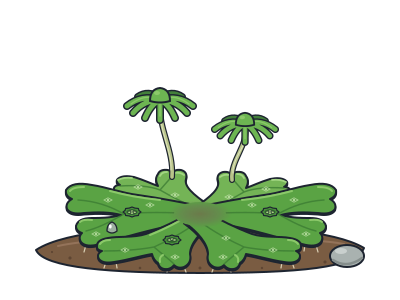
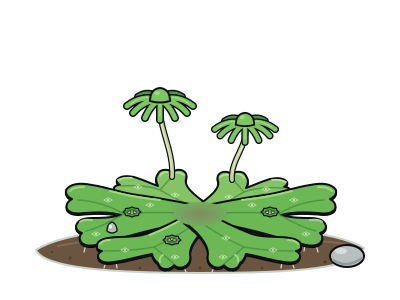
The horns are not leaves or flowers. They are the part of the plant that makes spores. They are thin and upright, usually about 1 to 2 centimetres tall and only about as thick as a fine pencil lead. Most plant parts grow longer at their tips, but these horns grow from just above their base. As each horn ripens, its tip turns black and splits into two strips, releasing dark spores. Meanwhile the base keeps growing.
The rest of the plant is a flat rosette, no bigger than a fingernail. It looks like a tiny crumpled lettuce leaf lying on the soil. It has no leaves, stem, flowers or true roots, only fine hairs underneath that hold it in place.
Hornworts are relatives of mosses and liverworts. People often mistake hornworts for liverworts, but hornworts are a separate group with features of their own.
An algae-style trick
Field hornwort has pyrenoids, tiny parts of the cell that collect carbon dioxide to boost food-making. They are common in algae, but among land plants only some hornworts have them.
Missing chemicals
As far as scientists know, hornworts are the only group of land plants with no flavonoids at all. This family of chemicals is found in most other land plants.
Nothing to do with warts
The 'wort' in hornwort is an old word meaning 'plant' or 'herb'. A water plant called coontail is also known as hornwort, but it is not this plant.