A species
Pink salt archaeon
Halobacterium salinarum
A salt-loving microbe that turns brine pink and catches sunlight with a purple pigment.
You and the pink salt archaeon meet in the Archaea branch, shown at about 3.3 billion years ago (on 20 March, in a calendar from life's shared ancestor to today).
In very salty ponds and lakes, crowds of this tiny microbe help turn the water pink. Its name says 'bacterium', but it isn't one. It is an archaeon, from a separate branch of life. It needs water several times saltier than the sea and cannot live in fresh water or ordinary seawater.
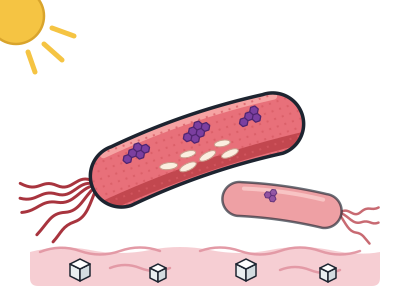
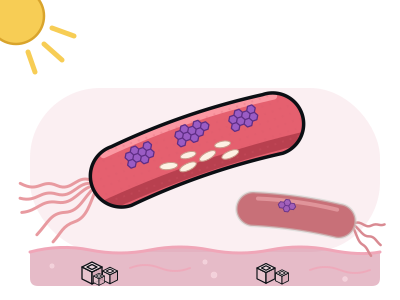
Its pink-red colour comes mostly from a red pigment in its membrane. That pigment belongs to the same broad family as the orange in carrots, and it helps protect the cell from damage by strong sunlight. The cell also makes a purple pigment that catches light. This purple pigment holds the same light-catching molecule, made from vitamin A, as the pigment in your eyes. When light hits it, it works like a tiny pump that helps the cell make energy. This is not photosynthesis like in plants: there is no green chlorophyll and no oxygen is given off.
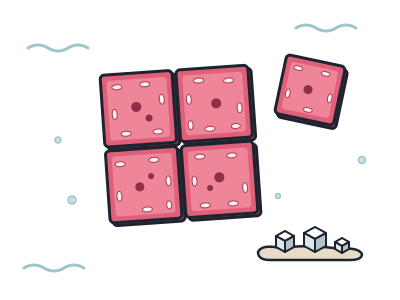
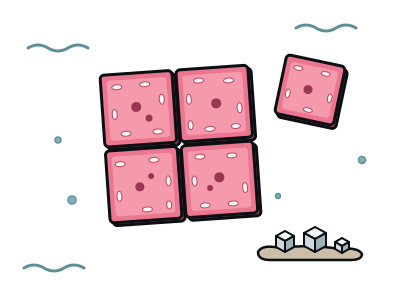
Each cell is a little rod a few thousandths of a millimetre long. About 15 to 30 would fit across a human hair. It swims by spinning long, whip-like tails like a propeller. Tiny gas-filled bubbles inside the cell let it float up towards oxygen and light. Its fellow salt-lover on the tree, the square archaeon, is shaped like a flat square, not a rod.
A switch for brain science
Studying its purple pigment helped pave the way for optogenetics. In this method, scientists use similar microbe pigments as light switches to study and control nerve cells. Possible treatments being explored include ones for eye diseases, Parkinson's and epilepsy.
Salty on the inside
It doesn't keep the salt out. Instead, it fills itself with potassium chloride, a salt, to match the brine outside. Its proteins have adapted so much that they need lots of salt to keep working.
No sweet tooth
It feeds mainly on amino acids, the building blocks of proteins. It cannot grow on sugars.