An extinct species
Frogamander †
Gerobatrachus hottoni
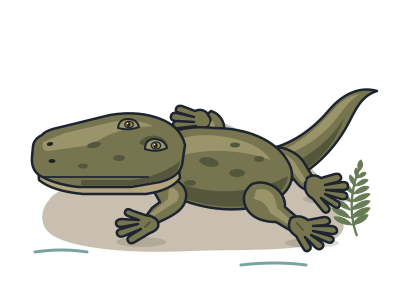
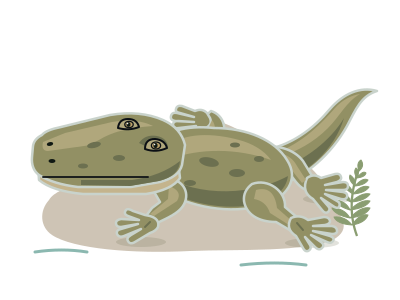
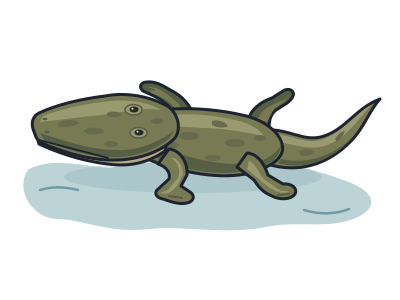
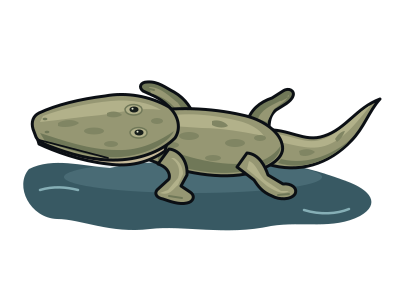
A frog-like head on a salamander-like body.
Lived about 299–274 million years ago.
You and the frogamander meet in the Four-limbed animals branch, shown at about 350 million years ago (on 1 December, in a calendar from life's shared ancestor to today).
Frogamander had a broad, frog-like head and a longer, tailed body that looked more like a salamander’s. This surprising combination explained its nickname. It was not a hybrid between the two animals. Instead, its bones offered clues to the family history of frogs and salamanders. The fossil did not establish it as their direct ancestor.
It lived in the early Permian; early reports dated its fossil to about 290 million years ago. It belonged to the temnospondyls, an extinct group of amphibian-like, four-limbed animals. The known skeleton measured about 11 centimetres long, roughly the length of a small teaspoon. That measurement came from one individual; its usual adult size was not established.
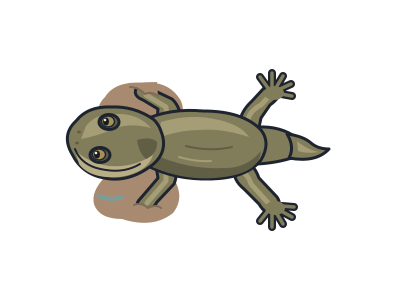
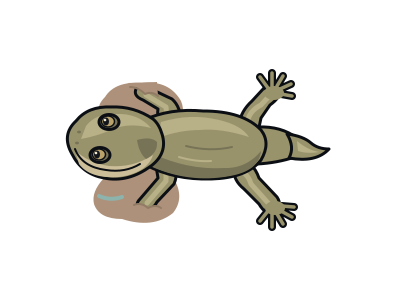
The original description rested on one nearly complete skeleton from Texas. Its connected bones were preserved in red siltstone, with the skeleton exposed from below. Parts of the limbs, skull and shoulder region were missing. The fossil provided evidence of its skeleton, but did not document its skin, colours or behaviour.
Seventeen spine bones
It had 17 backbone bones before its hips.
Tiny teeth
One bone at the front of its upper jaw carried at least 21 tiny, single-pointed teeth.
An honoured researcher
Its scientific name meant “Hotton’s elder frog” and honoured Smithsonian fossil researcher Nicholas Hotton.