An extinct species
Koolasuchus †
Koolasuchus cleelandi
An ancient amphibian survivor in Australia’s cold dinosaur rivers.
Lived about 125–120 million years ago.
You and the koolasuchus meet in the Four-limbed animals branch, shown at about 350 million years ago (on 1 December, in a calendar from life's shared ancestor to today).
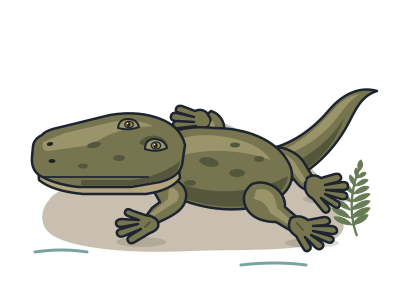
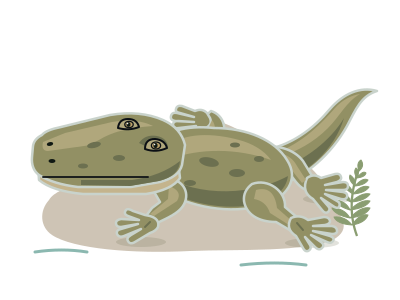
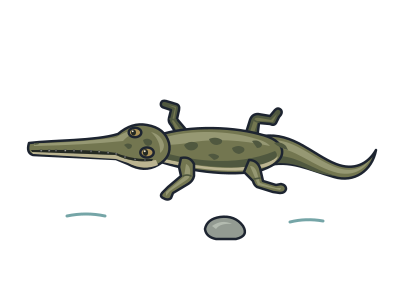
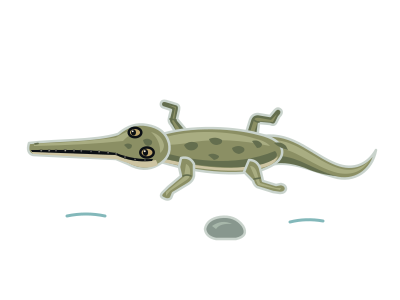
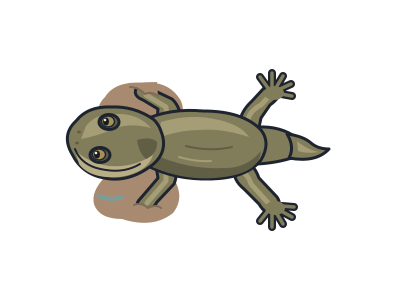
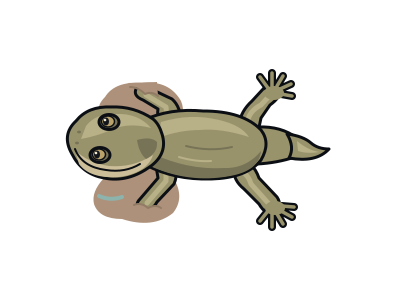
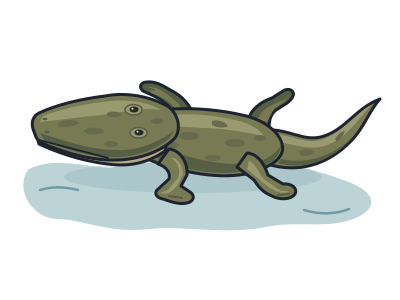
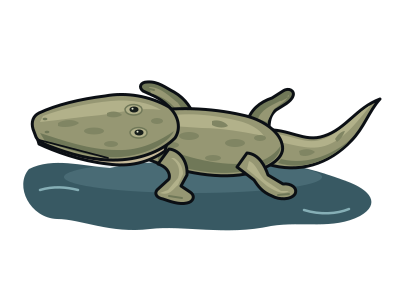
One of the last known temnospondyls—an ancient group of amphibians—this animal lived alongside dinosaurs in cold, polar Australia. It belonged to the same broad group as Eryops, Prionosuchus and Frogamander. Despite its crocodile-like appearance, it was neither a crocodile nor a dinosaur.
It lived about 125 to 120 million years ago. Its part of Australia lay inside the Antarctic Circle, in a valley forming as Australia separated from Antarctica. The poles were warmer than today, so this was a landscape of rivers and vegetated flood plains, not a modern Antarctic ice sheet.
Fossils showed a broad head and large, cone-shaped teeth. These suggested a powerful river predator. Reconstructions put its length at about four metres, roughly the length of a car, although estimates varied. Coarse sandstone around its remains suggested strong river currents, but this might have recorded where its bones were buried rather than the waters it preferred.
Two people in one name
Its name honoured fossil preparator Lesley Kool and fossil collector Michael Cleeland.
Named in 1997
Scientists formally described and named it in 1997.
A small stretch of coast
Its known fossils came only from coastal rock exposures between San Remo and Kilcunda in south-eastern Victoria.