A species
Bombardier beetle
Brachinus crepitans
A tiny beetle with a scalding rear defence.
You and the bombardier beetle meet in the Two-sided animals branch, shown at about 580 million years ago (on 11 November, in a calendar from life's shared ancestor to today).
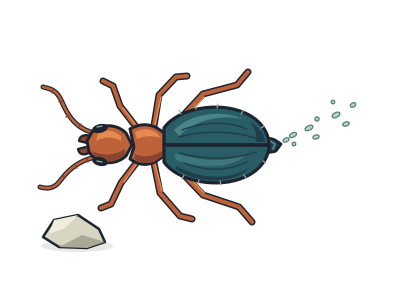
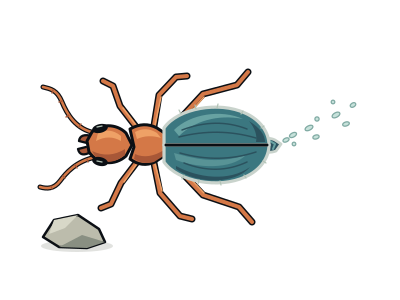
The bombardier beetle blasts a hot chemical spray from its rear at attackers. The spray can reach about 100°C, roughly the temperature of boiling water, though not every discharge is that hot. An audible pop or crackle accompanies the spray. This is a chemical defence, not fire, and it comes from the opposite end to the mouth.
Despite this unusual defence, it belongs among the beetles, alongside familiar relatives such as ladybirds and stag beetles. More specifically, it is a ground beetle. A tough chamber at the rear protects its other internal organs. Firing does not make the beetle burst or sacrifice itself: it can use its defence repeatedly.
The adult is only about a centimetre long or less. Its head and the narrow section behind it are reddish-orange. The broader rear section can look blue-grey, grey-green or almost black.
Ground beetle, flying beetle
Despite its family name, this species has working wings and can fly readily.
A shared name
“Bombardier beetle” is a common name shared by hundreds of species worldwide.
Summer breeding
The British ground-beetle atlas describes this species as a summer breeder.
Next to it on the tree
- Green tiger beetleA metallic green sprinter that runs so fast it briefly goes blind and must stop to look.
- Great diving beetleA big pond beetle that carries an air bubble under its wing cases.
- Whirligig beetleSpins on the water surface with eyes split in two, one pair above and one below.
- Violin beetleA paper-thin ground beetle shaped like a violin that slips into bracket fungi.
- Violet ground beetleA night-hunting garden beetle with a purple sheen that eats slugs.