A group of living things
Armadillos and glyptodonts
Cingulata
The armadillo family once included car-sized giants.
This branch is shown at about 45 million years ago; its age is a rough estimate.
You and armadillos and glyptodonts meet in the Placental mammals branch, shown at about 95 million years ago (on 23 December, in a calendar from life's shared ancestor to today).
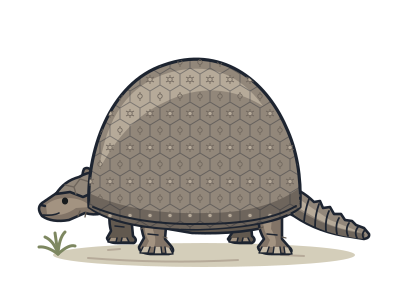
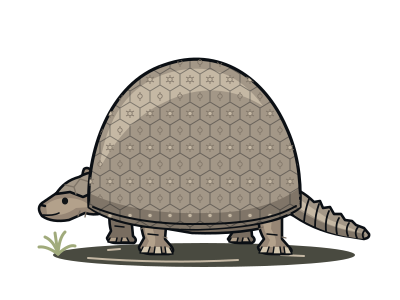
Car-sized glyptodonts were giant armadillos, not a separate group of lookalikes. Ancient DNA revealed their place inside the armadillo family tree. The DNA came from armour belonging to Doedicurus, one kind of glyptodont, rather than from Glyptodon itself. These giants were extinct relatives of living armadillos, not ancestors from which all today's armadillos descended.
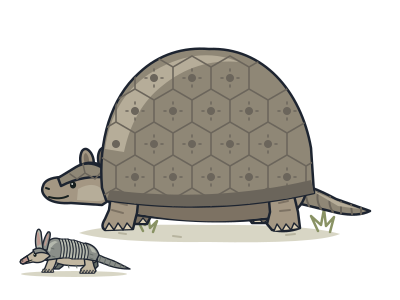
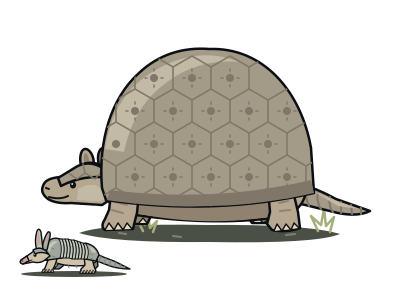
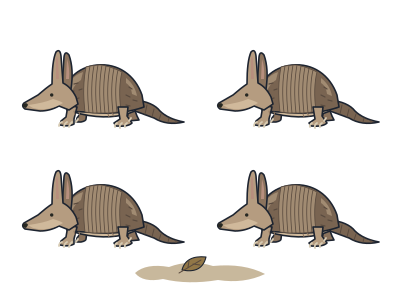
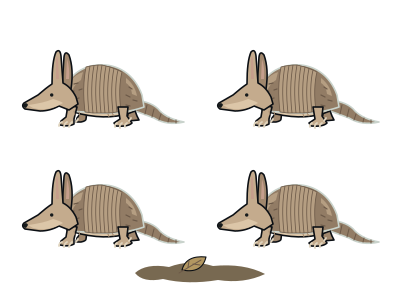
Despite their reptile-like armour, armadillos are mammals, on the same wider family branch as sloths and anteaters. Picture a nine-banded armadillo beside a Glyptodon: one small and low to the ground, the other about the length of a small car. They are just two examples of this varied family.
Fossil armour shows that glyptodonts had bone growing within their skin. These armoured giants ate plants. Living La Plata three-banded armadillos mainly eat ants and termites instead. Some glyptodonts survived until roughly 10,000 years ago, around the end of the last ice age.
Small to large
Living armadillos range from pink fairy armadillos about 15 centimetres long to giant armadillos about 1.5 metres from nose to tail.
Heavy armour
Some glyptodont shells are estimated to have weighed more than about 500 kilograms—up to one-fifth of the animal's total weight.
Across the Americas
Different glyptodont species lived in forests, grasslands and other habitats. Together, their ranges stretched from the southern United States to Patagonia.
Inside armadillos and glyptodonts
- Nine-banded armadilloAlmost always gives birth to identical quadruplets.
- GlyptodonA small-car-sized armadillo relative with a solid dome of bony armour.
- Pink fairy armadilloA palm-sized pink armadillo that "swims" through sand, with a flat plate on its rump.
- Giant armadilloThe largest living armadillo, with a huge middle claw for tearing open termite mounds.
- Brazilian three-banded armadilloOne of the few armadillos that can roll into a complete armoured ball.