An extinct group
Glyptodon †
Glyptodon
An armadillo relative on a small-car scale.
Lived about 2.5–0.012 million years ago.
You and glyptodon meet in the Placental mammals branch, shown at about 95 million years ago (on 23 December, in a calendar from life's shared ancestor to today).
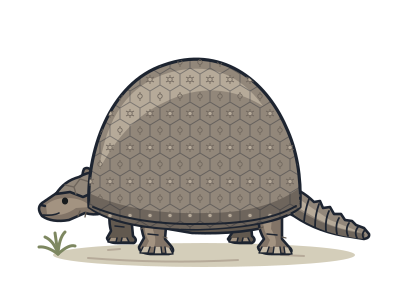
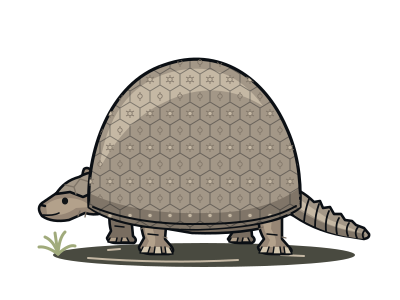
Imagine an armadillo relative on the scale of a small car, carrying a rigid, domed shell. This mammal belonged to an extinct branch within the armadillo family tree, not to the tortoises or dinosaurs. Its wider family also included sloths and anteaters.
Glyptodon included several species that lived in South America during the Ice Age. Unlike the flexible bands of a nine-banded armadillo, their body armour formed a rigid dome. They ate plants. Bones and teeth place these animals within the wider family of armadillos, sloths and anteaters.
Fossils preserved bony armour, teeth and other bones. These showed the animals’ hard parts. Museum accounts put large individuals at about three metres long, with estimated weights approaching two tonnes. These were estimates for large animals, rather than the size of every species or individual.
A thousand pieces
The Paris museum described its fossil animal's shell as made from about a thousand small bony plates.
A ringed tail
Glyptodon reticulatus had eight or nine movable armour rings around its tail, followed by a short armoured tip.
Patterned armour
Shell plates of Glyptodon reticulatus had grooved, net-like or flower-like patterns. These varied across the shell and with age.
Next to it on the tree
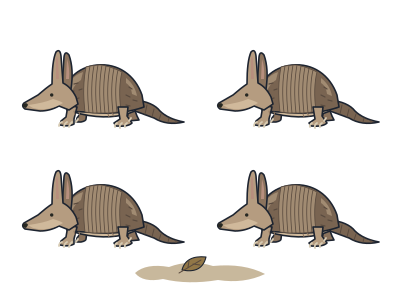
- Nine-banded armadilloAlmost always gives birth to identical quadruplets.
- Pink fairy armadilloA palm-sized pink armadillo that "swims" through sand, with a flat plate on its rump.
- Giant armadilloThe largest living armadillo, with a huge middle claw for tearing open termite mounds.
- Brazilian three-banded armadilloOne of the few armadillos that can roll into a complete armoured ball.