A species
Grappling-hook archaeon
Candidatus Altiarchaeum hamiconexum
A tiny ball covered in grappling hooks that knits itself into a living net
You and the grappling-hook archaeon meet in the Archaea branch, shown at about 3.3 billion years ago (on 20 March, in a calendar from life's shared ancestor to today).
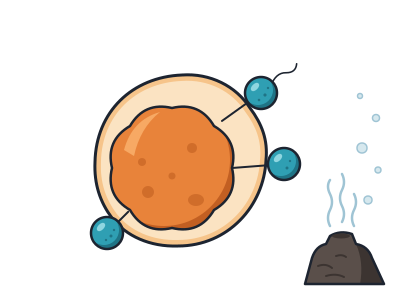
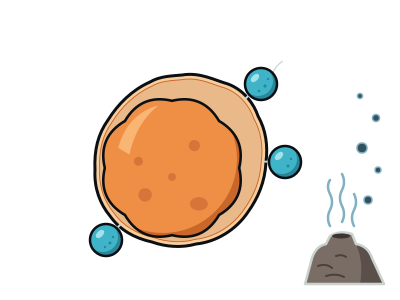
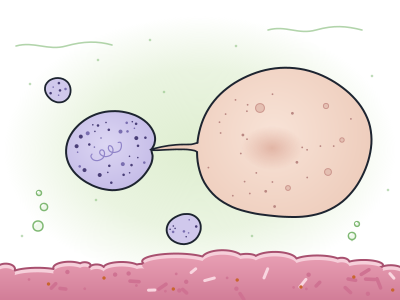
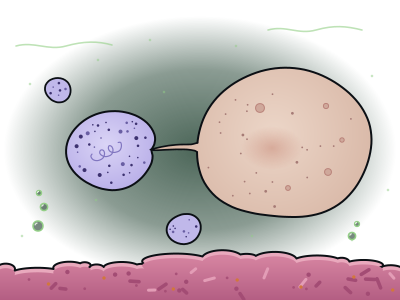
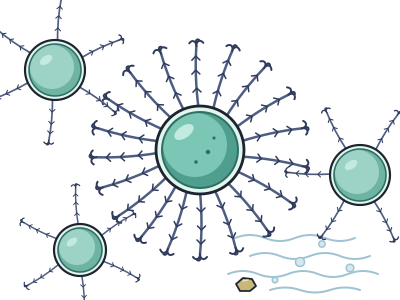
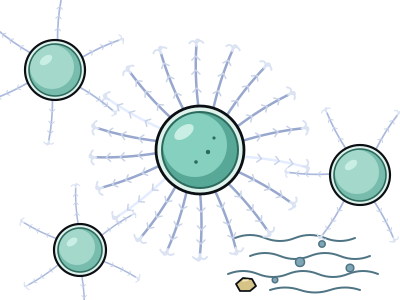
Picture a tiny ball covered in about a hundred hooks. Each hook, called a hamus, looks like barbed wire. Sets of three small prickles stick out along its length, and the tip ends in a three-pronged grappling hook. The cells use these hooks to latch on to their neighbours, about six each, and so knit a net-like film. It lives in cold, oxygen-free, sulfur-rich springs near Regensburg in Germany, where the water is only about 10 °C.
A single cell is about 0.6 micrometres across. That is roughly a hundredth of the width of a human hair, and its hooks are often longer than the cell is wide. Near the surface the cells pack into blobs up to about 3 mm across. Threads of bacteria join the blobs, so they look like a string of pearls in the water. This archaeon is not a minor member of its community. It makes up most of it.
On the tree it sits among the DPANN archaea, next to Nanoarchaeum. Many of its DPANN relatives are extremely small cells that depend on a host to survive. This one is the surprise. It makes its own food from carbon dioxide, and its set of genes has not shrunk.
A rare double skin
Its cell has two membranes, an inner one and an outer one, with a thin gap between them. Archaea are rarely seen with this.
Hooks that grip many surfaces
Researchers compared the hooks to fishhooks, grapples and anchors. They let the cells stick firmly to surfaces made of many different materials.
Relatives deep below ground
Its close relatives live in deep underground water in other parts of the world, often in large numbers. There they are attacked by many viruses, which burst the cells open.