An extinct species
Strelley Pool stromatolites †
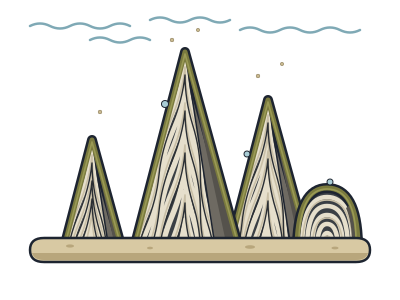
Strelley Pool Formation stromatolites
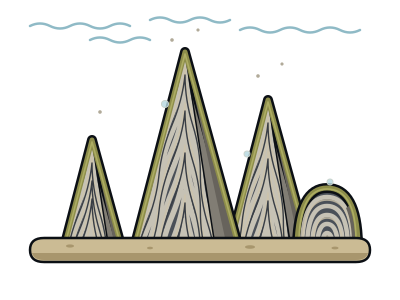
Rock cones built by microbes 3.4 billion years ago, among the oldest widely accepted signs of life
Lived about 3,430–3,350 million years ago.
You and the strelley pool stromatolites meet in the All life branch, shown at about 4.2 billion years ago (on 1 January, in a calendar from life's shared ancestor to today).
About 3.43 to 3.35 billion years ago, long before any plants or animals, sunlight reached the floor of a shallow sea. Thin mats of microbes lived there. Over time they built pointed cones of rock. These layered structures are among the oldest widely accepted signs of life on Earth.
The fossils are not bodies. They are fine, wavy layers stacked up like a pile of very thin blankets. The layers formed cones about as tall as a teacup, as well as domes, waves and patterns that look like giant egg cartons.
Nobody knows exactly which microbes built them. They were probably bacteria, but they cannot be matched to any living group. That is why they sit on their own branch near Bacteria and Archaea, the two great groups of microbes whose cells have no nucleus. One idea is that thread-like microbes glided over one another towards the light and picked up mineral grains as they went. Nobody has seen this happen in the fossils, though.
For years, some scientists thought that sediment piling up through chemical and physical processes alone might have made these shapes. Then a study in 2006 found seven different shapes along a line about 10 kilometres long. The study argued that they were too varied to have formed without life. Its authors compared this 'microbial reef' with a coral reef today.
Practice for other worlds
NASA studies these rocks for clues about how to recognise signs of ancient life on other planets.
Life was already busy
The lead scientist of the 2006 study said that life at this time was not just getting a toe-hold but was 'well established'.
Tiny cells nearby
The same rock formation also holds what are thought to be microscopic fossil cells, each about a tenth of the width of a human hair. They were preserved between grains of sand on what has been called the oldest known beach on Earth.