A species
Nanoarchaeum
Nanoarchaeum equitans
A tiny cell that can only live by riding on a bigger one
You and the nanoarchaeum meet in the Archaea branch, shown at about 3.3 billion years ago (on 20 March, in a calendar from life's shared ancestor to today).
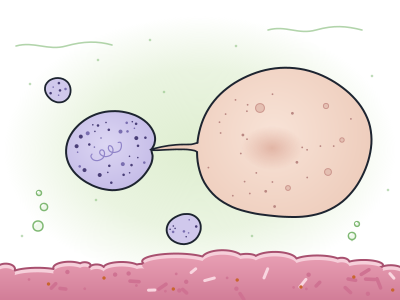
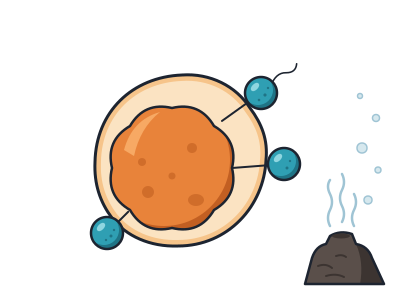
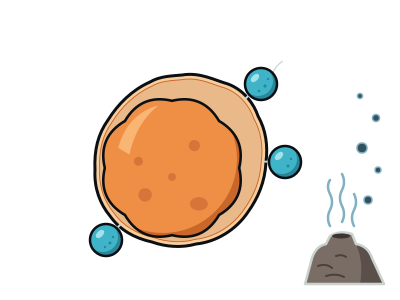
Imagine a cell so small that about 2,500 of them in a row would stretch only one millimetre. This tiny archaeon is one of the smallest cells known, and it cannot live on its own. It spends its whole life attached to the outside of a bigger archaeon called Ignicoccus, which is roughly five times wider. Its species name means 'riding', because it rides on its host like a bead stuck to a ball.
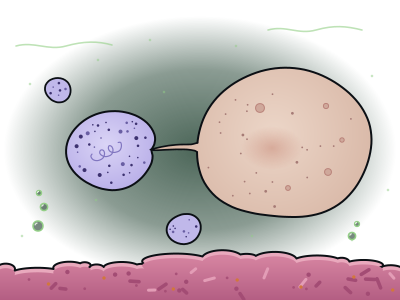
The pair lives in hydrothermal vents, cracks in the sea floor where scorching water gushes out. They grow without oxygen, in water at about 75 to 98 °C. They do best at about 90 °C, not far below the boiling point of water.
Riding is more than hitching a lift. A very thin stalk pushes through the host's outer layers, so the insides of the two cells touch. The rider takes the fats and protein building blocks it needs from its host, because it has lost almost all the genes to make them itself. This costs the host. Even one rider slows down how fast the host divides.
When scientists first described it, it was so unlike any other archaeon that they gave it a brand-new major group of its own.
A tiny instruction book
Its DNA is only about 491,000 'letters' long, with about 550 genes. When it was read in 2003, it was the smallest microbial genome known.
Genes in pieces
Some of its genes are split in two. The halves of one gene sit about half the chromosome apart, but the two protein parts still work once they join up.
Crowded hosts
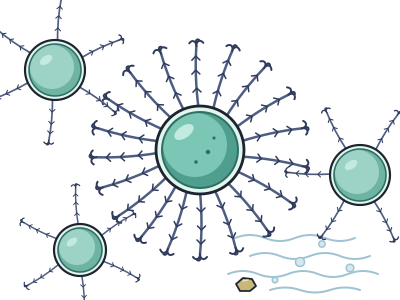
When a lab culture is growing fast, about a quarter of host cells carry one to three riders. Later, most hosts are covered, often by around 10 riders each.