An extinct species
Tribrachidium †
Tribrachidium heraldicum
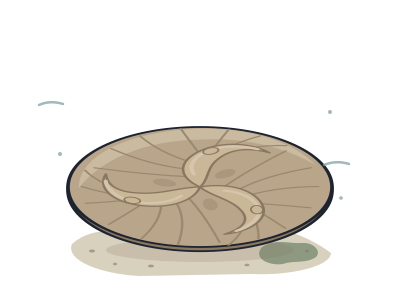
Three curling arms, with no living match
Lived about 555–550 million years ago.
You and the tribrachidium meet in the Animals branch, shown at about 700 million years ago (on 1 November, in a calendar from life's shared ancestor to today).
This small disc had three curling arms—a body plan with no known match among living animals. Its exact connection to living animal groups remained unknown. It lived about 555 to 550 million years ago, on shallow seabeds where storms stirred up and deposited sand.
Its body was usually about 2–4 centimetres across, roughly coin-sized. The arms were raised features on a rounded body, not separate walking limbs. They curled clockwise towards the edge, with three shallow hollows between them near the top.
The fossils preserved circular impressions of a soft body rather than bones. They recorded its outline and surface details, but not its complete inner anatomy. Fossils were found in South Australia, Russia and Ukraine. Sand laid down by storms helped preserve these traces, leaving researchers with detailed shapes to study rather than the original bodies.
A bump on each arm
Each main arm had a small rounded swelling near its bend.
One or a crowd
At Nilpena, some fossil beds preserved just one individual, while others preserved more than 100.
Named after a symbol
Its name referred to its resemblance to a three-armed symbol used on coats of arms.
Next to it on the tree
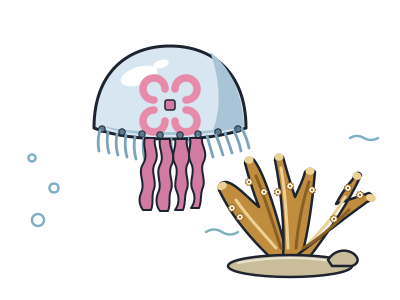
- Jellyfish and coralsStinging-cell animals; a coral reef is built by tiny jellyfish relatives.
- Two-sided animalsA left, a right, a front and a back: the body plan of worms, insects, octopuses and you.
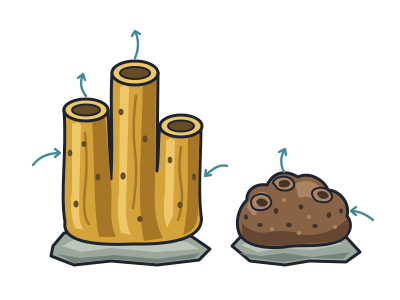
- SpongesAnimals with no brain, gut or muscles that pump water through their bodies to filter out food.
- PlacozoanThe simplest-looking animal: a flat, crawling smear of cells with no front, back, mouth or nerves.
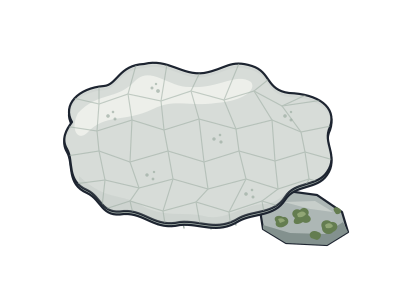
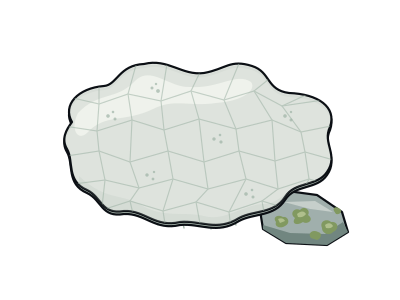
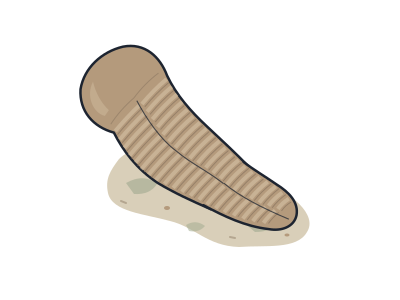
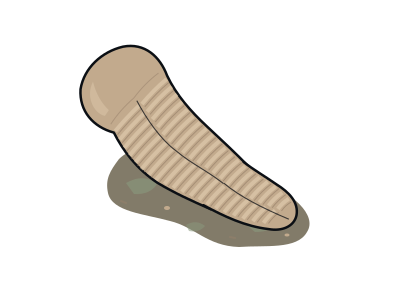
- DickinsoniaA rippled oval mat from 555 million years ago; fat molecules in its fossils show it was an animal.
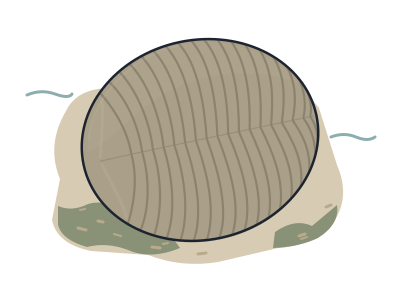
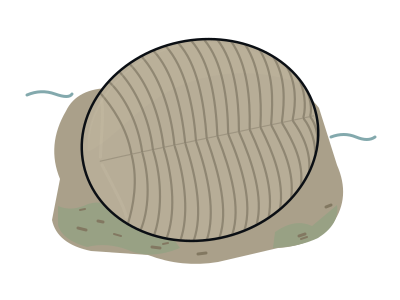
- SprigginaA segmented, shield-headed Ediacaran creature that looks like it might have had a front end.
- Comb jelliesGlassy hunters that swim with rows of beating hairs, scattering rainbows as they go.
- RangeomorphsFrond-shaped creatures built from repeating branches, the first large living things on the deep seafloor.
- CloudinaA stack of tiny cones, like nested paper cups, that is one of the first animals to build a hard shell.