A group of living things
Pufferfish and kin
Tetraodontiformes
Odd shapes, unusual teeth and surprising relatives.
This branch is shown at about 80 million years ago; its age is a rough estimate.
You and pufferfish and kin meet in the Bony fish and their descendants branch, shown at about 430 million years ago (on 24 November, in a calendar from life's shared ancestor to today).
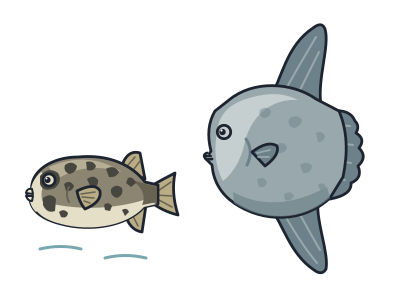
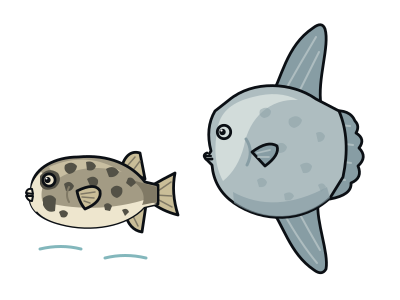
A round pufferfish and an enormous ocean sunfish may look nothing alike, but they are relatives. Prickly porcupinefish, triggerfish, filefish and boxfish belong to their group too. Unusual teeth are a shared theme: some have teeth joined into beak-like plates, while others have different arrangements. The group includes more than 400 living species.
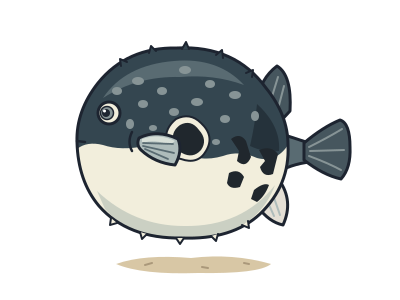
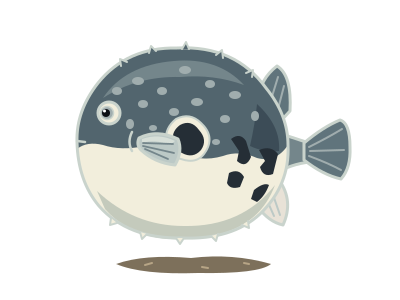
A true pufferfish has four large front tooth plates, two above and two below. Together they form a strong beak for crushing hard-shelled food. Underwater, a threatened puffer can pump water into its stretchy stomach, becoming harder to swallow. Other relatives have different defences: boxfish, for example, wear armour made from bony plates.
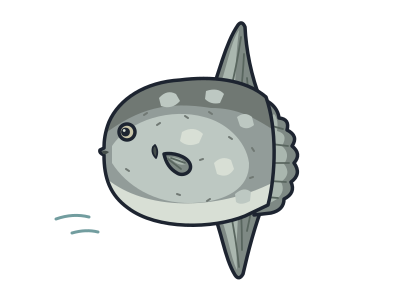
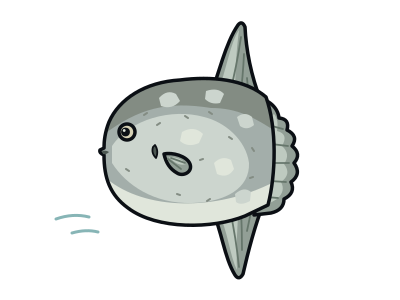
An ocean sunfish also has teeth fused into plates, inside a mouth that looks tiny beside its body. An adult has no ordinary tail fin. Instead, its rear edge forms a rounded rudder-like structure. It swims by sweeping its tall upper and lower fins together, rather than simply drifting along.
Not all sea fish
Some pufferfish live in freshwater rivers in South America, Africa and Southeast Asia.
Deep traveller
One tracking study in the north-west Atlantic recorded an ocean sunfish reaching about 840 metres deep.
Sand-circle builders
Males of one pufferfish species use their fins to make circular sand nests about two metres across.
Inside pufferfish and kin
- Tiger pufferfishInflates into a spiky ball and carries a deadly toxin; served as fugu only by licensed chefs.
- Ocean sunfishOne of the heaviest bony fish, a giant swimming head that can weigh over two tonnes.
- Long-spine porcupinefishIts spines lie flat until it gulps water and swells into a spiky ball.
- Picasso triggerfishLooks like a painting, and locks its back spine upright to wedge itself into reef holes.
- Yellow boxfishA spotted yellow cube in bony armour, whose shape inspired a car design.
Next to it on the tree
- Wrasses and parrotfishColourful reef fish with protruding teeth, many able to change sex during their lives.
- Perch, groupers and scorpionfishA vast group of spiny fish, from lake perch to venomous scorpionfish and Antarctic icefish.
- AnglerfishesFish that fish: a spine on the head became a rod with a lure on the end.
- Surgeonfishes and Moorish idolReef grazers with a blade-like spine at the base of the tail.
- Emperor angelfishYoung ones are blue with white rings and look like a different species from the striped adults.
- Copperband butterflyfishUses a long tweezer snout to pick food from reef cracks, and has a fake eye near its tail.
- Largemouth bassThe most popular sport fish in North America, a big-mouthed sunfish rather than a true bass.