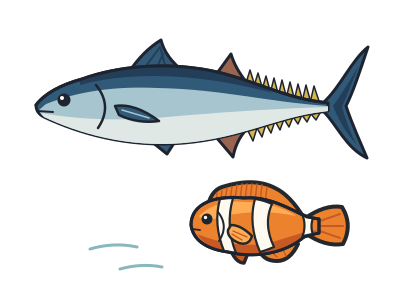
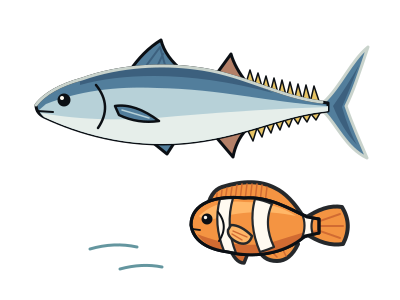
A group of living things
Spiny-finned fish
Percomorpha
A vast fish branch flourished in the age of mammals.
This branch is shown at about 110 million years ago; its age is a rough estimate.
You and spiny-finned fish meet in the Bony fish and their descendants branch, shown at about 430 million years ago (on 24 November, in a calendar from life's shared ancestor to today).
Clownfish, tuna, flatfish and puffers are part of the great fish expansion of the age of mammals. These strikingly different fish belong to one enormous family-tree branch. Picture a compact clownfish beside a streamlined tuna: their shapes look very different, yet both belong here, alongside seahorses and many other surprising relatives.
This branch was already present in the age of dinosaurs. During the age of mammals, its members expanded into a remarkable variety of shapes. These include reef fish flattened from side to side, ocean hunters, sideways-lying flatfish and puffers. Research suggests this variety built up over a long period, rather than in one sudden burst.
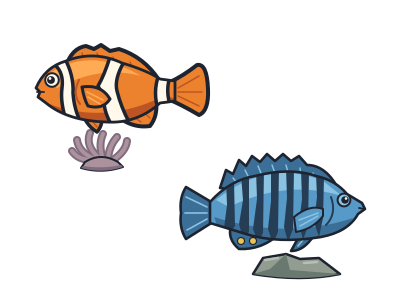
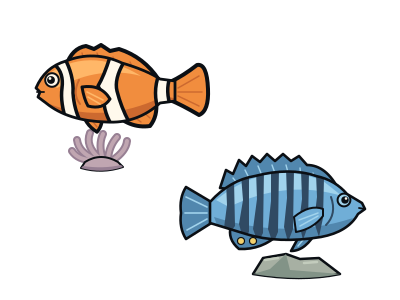
Today, members live in freshwater, coastal seas and the open ocean. Some occupy the deep sea. Others live around tropical reefs, where clownfish shelter among sea-anemone tentacles. The anemones’ stings help keep fish predators away.
Water-filled defence
Pufferfish and porcupinefish enlarge themselves for defence by drawing water into their stomachs.
A smaller family within
Clownfish belong to the damselfish family.
More than tiny hunters
Clownfish eat both tiny drifting animals and algae.
Inside spiny-finned fish
- Clownfish, cichlids and kinA surprising family: clownfish, cichlids and flying fish share a common ancestor.
- Flatfish, swordfish and kinFlatfish are cousins of swordfish and jacks, a link revealed only by DNA.
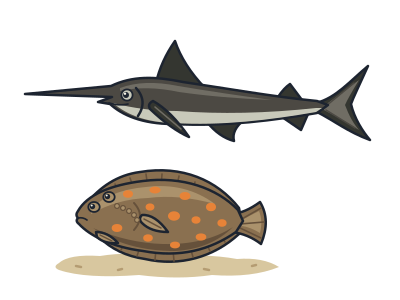
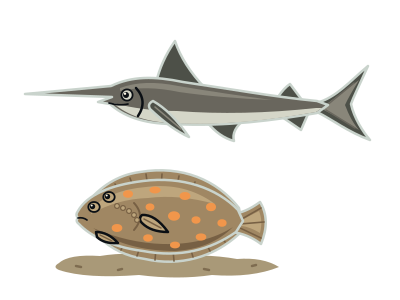
- Tunas and mackerelsStreamlined ocean racers built for nonstop swimming, many with fins that tuck into grooves.
- Seahorses and kinOdd-shaped fish with tube snouts or showy fins: seahorses, seadragons and dragonets.
- Gobies and cardinalfishSmall bottom-dwelling fish that make up one of the largest fish groups on reefs.
- Labyrinth fishes and snakeheadsFreshwater fish with an extra breathing organ in the head that lets them gulp air.
- Perch, wrasses, puffers and kinThe largest branch of spiny-finned fish, holding most reef fish and perch-like fish.
Next to it on the tree
- Oarfish and opahsOpen-ocean oddballs: a silver ribbon many metres long and a warm-blooded fish shaped like a dinner plate.
- Cods and hakesCold-water white fish, many with a whisker on the chin, and the backbone of fish-and-chips.
- John DoryA paper-thin fish with a dark thumbprint spot, said in legend to be the mark of Saint Peter.
- Orange roughyCan live over 200 years, so deep-sea fishing in the 1980s and 90s emptied whole seamounts.