A group of living things
Flatfish, swordfish and kin
Carangaria
An unexpected family link, hidden in DNA
This branch is shown at about 70 million years ago; its age is a rough estimate.
You and flatfish, swordfish and kin meet in the Bony fish and their descendants branch, shown at about 430 million years ago (on 24 November, in a calendar from life's shared ancestor to today).
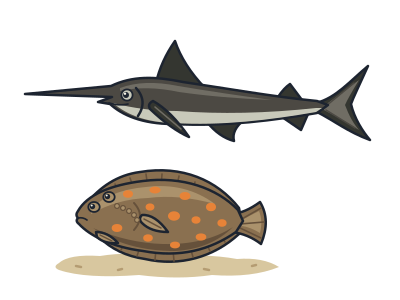
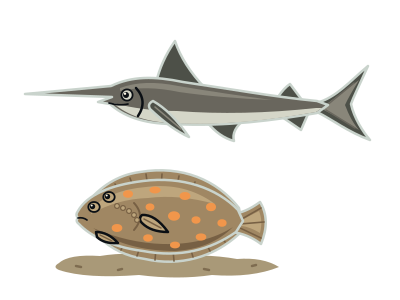
A plaice resting on the seabed hardly looks like a swordfish swimming through the ocean. Yet flatfishes, swordfish and jacks belong to the same wider family branch. DNA studies revealed this surprising connection. Swordfish were once grouped closely with tuna, but their similar shapes as powerful swimmers do not mean they are such close relatives.
A European plaice lies on its left side, with both eyes normally facing upwards on the right. Its upward-facing side is brown with orange spots; the side against the seabed is white. It spends much of its time resting on the bottom, often partly buried in sand.
A swordfish has a long body and a pointed bill. That bill is an extended upper jaw, not a separate horn. These fish live in the open ocean and dive hundreds of metres. The contrast with a flatfish shows how different members of one family branch can become.
Changeable camouflage
Plaice can change their background colour to match the seabed, although their orange spots may still stand out.
A built-in warmer
Special tissue linked to an eye muscle warms a swordfish’s brain, helping it cope with cold water during deep dives.
Growing out of scales
Young swordfish have scales, but adults have neither body scales nor teeth in their jaws.
Inside flatfish, swordfish and kin
- FlatfishesFish that lie on one side, with both eyes on top; the lower eye moves across as they grow.
- BillfishesOcean hunters with a long spear for a snout, used to slash and stun fish.
- Great barracudaA long silver ambusher that curiously follows snorkellers and is drawn to anything shiny.
- Banded archerfishSpits jets of water to knock insects off leaves, aiming around the bend of light at the surface.
- Live sharksuckerIts back fin became a suction pad, so it hitches rides on sharks, turtles and whales.
- Mahi-mahiA blunt-headed blue and gold ocean fish that grows from egg to adult in a few months.
- BarramundiAn Australian favourite that starts life male and later becomes female.
Next to it on the tree
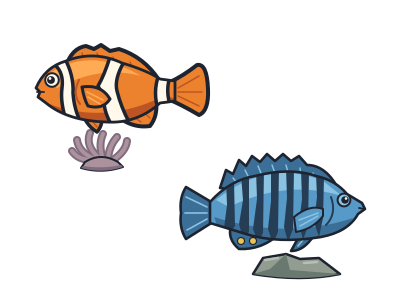
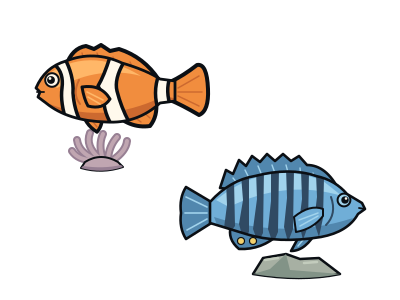
- Clownfish, cichlids and kinA surprising family: clownfish, cichlids and flying fish share a common ancestor.
- Tunas and mackerelsStreamlined ocean racers built for nonstop swimming, many with fins that tuck into grooves.
- Seahorses and kinOdd-shaped fish with tube snouts or showy fins: seahorses, seadragons and dragonets.
- Gobies and cardinalfishSmall bottom-dwelling fish that make up one of the largest fish groups on reefs.
- Labyrinth fishes and snakeheadsFreshwater fish with an extra breathing organ in the head that lets them gulp air.
- Perch, wrasses, puffers and kinThe largest branch of spiny-finned fish, holding most reef fish and perch-like fish.