An extinct species
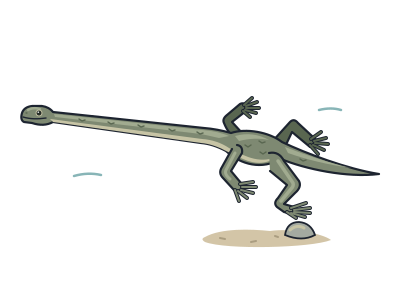
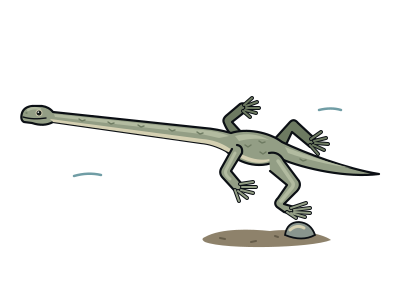
Tanystropheus †
Tanystropheus longobardicus
An extraordinarily long neck, with surprisingly few backbone bones.
Lived about 247–237 million years ago.
You and the tanystropheus meet in the Amniotes branch, shown at about 320 million years ago (on 4 December, in a calendar from life's shared ancestor to today).
Its extraordinarily long, relatively stiff neck made this reptile an unusual relative of crocodiles and birds. It belonged to an early branch of their wider family, outside the group containing crocodiles and dinosaurs. Fossil skeletons showed a small head, a narrow neck, a compact body, four legs and a tapering tail. Its neck had just 13 backbone bones, many greatly lengthened rather than multiplied into a snake-like chain.
It lived within the broad window of about 247 to 237 million years ago. Well-studied fossils from today's Swiss–Italian border dated to about 242 million years ago. This area was then a shallow coastal sea, part of the ancient Tethys Ocean.
For years, researchers grouped the small fossils and much larger animals under one species name. In 2020, the giants were named as a separate species. One important fossil of the small species preserved an almost complete skeleton, with most bones still connected. However, it was strongly flattened and lacked the rear part of its tail.
Adults, not babies
Growth rings in the small animals' limb bones showed that they were mature, not simply youngsters of the giant species.
Three-pointed teeth
Some of its teeth had three points, unlike the single-pointed teeth of its giant relative.
A mistaken flying reptile
Bones in the original fossil were first interpreted as wing-finger bones. They were later recognised as neck bones.
Next to it on the tree
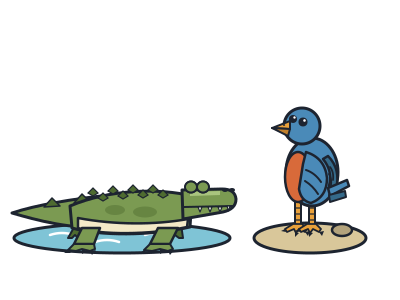
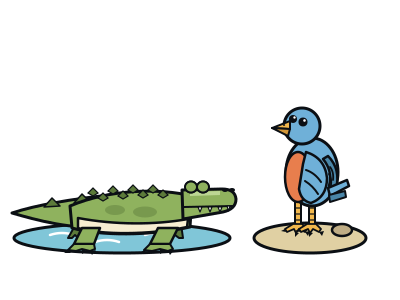
- Crocodiles and dinosaursThe 'ruling reptiles': crocodiles on one side, dinosaurs (birds included) on the other.
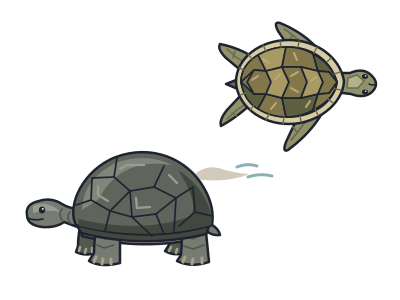
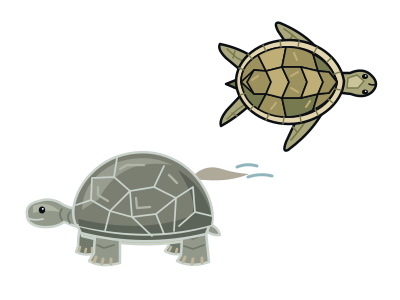
- Turtles and tortoisesA shell made from the ribs and backbone, unchanged in plan for 200 million years.
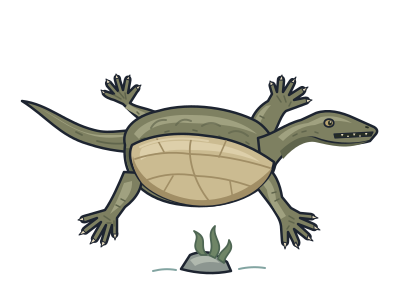
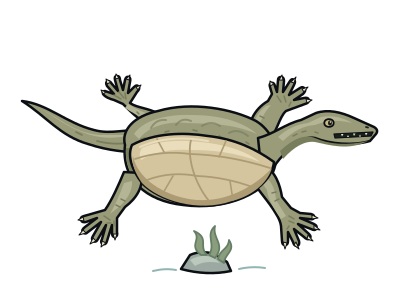
- OdontochelysA 'half-shelled' turtle with teeth: it had a belly shell before a back shell.
- ProganochelysAn early turtle with a full shell and a spiky tail, but it could not pull its head in.
- EuparkeriaA small, nimble Triassic reptile that looks like the ancestor of crocodiles and dinosaurs.