An extinct species
Proganochelys †
Proganochelys quenstedti
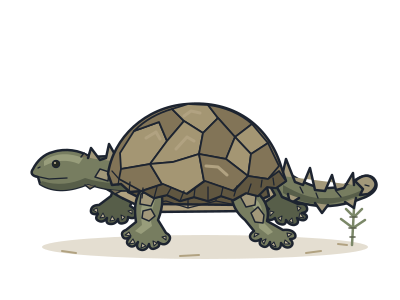
A full shell and a spiky tail—but no expert head-hiding.
Lived about 210–205 million years ago.
You and the proganochelys meet in the Amniotes branch, shown at about 320 million years ago (on 4 December, in a calendar from life's shared ancestor to today).
This early turtle relative already had a complete shell and a spiky tail, but it could not fold its neck away like many living turtles. It lived about 210 to 205 million years ago. Its fossils showed that a full shell came before the elaborate head-hiding movements familiar in many turtles today.
It belonged to an early branch of the turtle family, outside the group containing all living turtles and their shared ancestor. That made it a relative, not a proven direct ancestor of today's turtles and tortoises. Its familiar-looking shell was only part of the family story.
The shell was broad and low, rather than tall and domed like those of some land tortoises. Fossil bones showed an upper shell and a belly shield, joined by a solid bony bridge on each side. At the end of its armoured tail, the bones formed a club-like structure.
Not quite toothless
Its jaw edges lacked teeth, but tiny tooth-like structures remained on the roof of its mouth.
Five fingers and toes
Each hand had five fingers and each foot had five toes, with two bones in each finger or toe.
Extra armour
Bony armour also covered its neck and legs.
Next to it on the tree
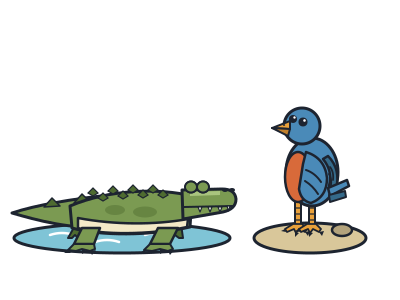
- Crocodiles and dinosaursThe 'ruling reptiles': crocodiles on one side, dinosaurs (birds included) on the other.
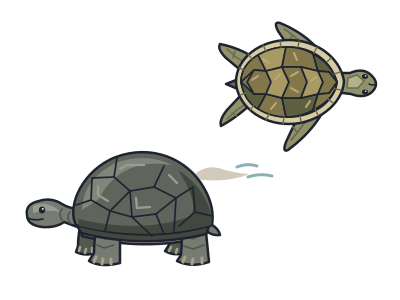
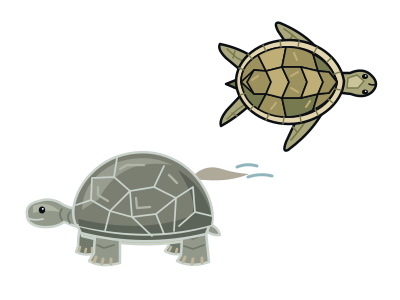
- Turtles and tortoisesA shell made from the ribs and backbone, unchanged in plan for 200 million years.
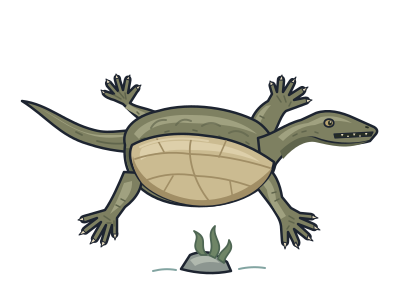
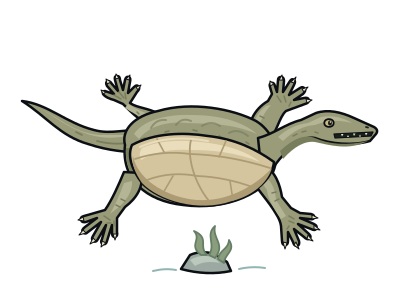
- OdontochelysA 'half-shelled' turtle with teeth: it had a belly shell before a back shell.
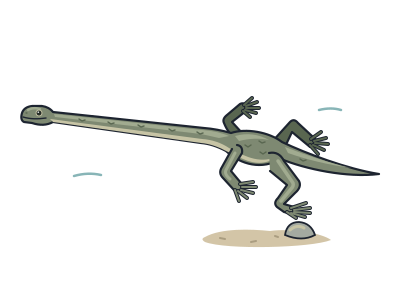
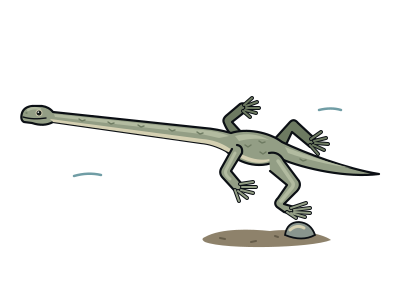
- TanystropheusA reptile whose stiff neck was longer than its body and tail together.
- EuparkeriaA small, nimble Triassic reptile that looks like the ancestor of crocodiles and dinosaurs.