A species
Purple sea urchin
Strongylocentrotus purpuratus
A rock-chewing ball of spines with clues to how bodies grow.
You and the purple sea urchin meet in the Starfish, sea squirts and us branch, shown at about 560 million years ago (on 13 November, in a calendar from life's shared ancestor to today).
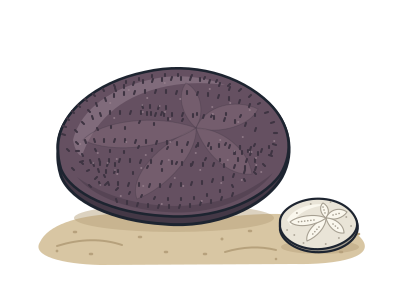
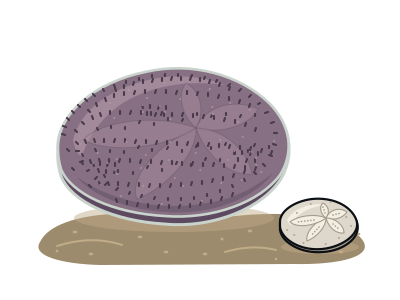
This spiky relative of starfish can chew rock with a five-toothed jaw. Its mouth faces downwards, and its teeth grind out a protective hollow in the rock beneath it. That makes a shelter, not a meal. The flat sand dollar beside it on the tree is another kind of sea urchin, despite its very different shape.
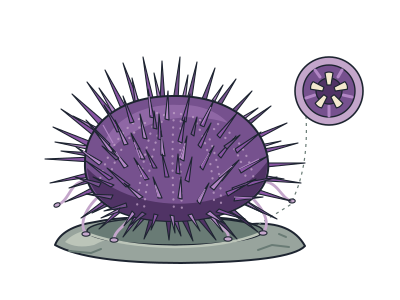
Under the spines sits a hard casing made of joined skeletal plates, rather than a shell like a snail’s. Its basic body plan repeats in five parts. Sea cucumbers, brittle stars and feather stars are relatives too, despite their very different shapes.
Its other claim to fame lies inside its cells. Scientists published its genome—the complete set of DNA instructions—in 2006. Its transparent embryo, an animal in its earliest stages of development, lets researchers watch structures taking shape. In 2008, researchers used those instructions to map how interacting genes guide cells that build tiny skeletal rods. This explained one group of developing cells, not how the entire body forms.
Purple comes later
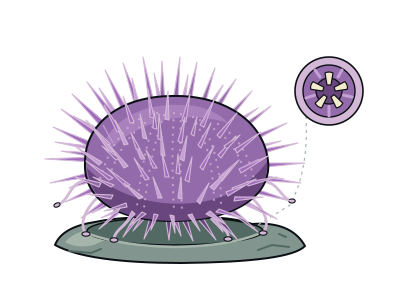
Young individuals often have mostly pale green spines, which become purple as they mature.
Feet that help it breathe
Its soft tube feet exchange gases with seawater, helping it breathe.
Mostly a seaweed eater
It mainly eats algae, including kelp, but also eats some animal material, such as barnacles and sponges.