A species
Giant salp
Salpa maxima
Jelly-like barrels that clone into ocean-going chains.
You and the giant salp meet in the Chordates branch, shown at about 550 million years ago (on 14 November, in a calendar from life's shared ancestor to today).
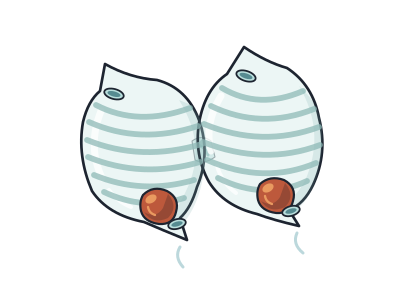
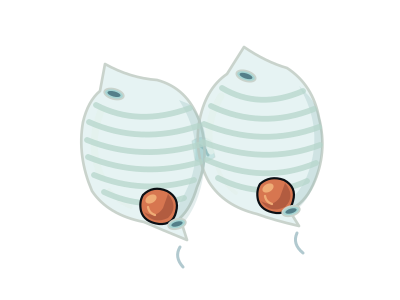
Solitary giant salps are jelly-like barrels that produce chains of clones several metres long. Both forms jet through the ocean. Each chain is many animals attached side by side, not one stretched-out creature. Their unlikely relatives include sea squirts and larvaceans: all belong to a group called tunicates. Tunicates have no backbone, yet they belong to the same wider animal group as humans.
Their life cycle alternates between two generations. A solitary salp produces connected copies of itself, which detach as a chain. The chain generation reproduces using eggs and sperm instead. Each chain member can grow a baby inside its body. That baby leaves to begin life as a solitary salp, ready to start the cycle again.
Bands of muscle squeeze water through the body, pushing the animal along without paddling limbs. The same flow brings oxygen and food inside. A brick-red ball containing the stomach and other organs shows through the clear body near the rear. Along a chain, these colourful balls line up on one edge.
Not the biggest
Despite its name, the giant salp is not the largest salp species.
An ocean meal
Salps are food for fish, turtles and seabirds.
Carbon on the move
Sinking salp droppings and bodies carry carbon from surface waters towards the deep ocean.
Next to it on the tree
- Sea squirtOur closest invertebrate relatives: they start as swimming tadpoles, then settle and absorb their own brain.
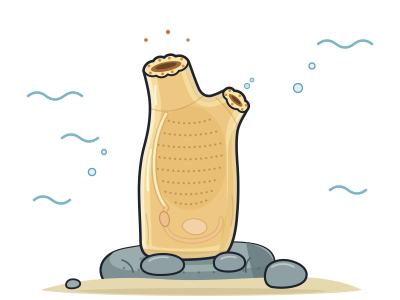
- LarvaceanA tiny tadpole that builds a mucus 'house' to filter food, and throws it away several times a day.
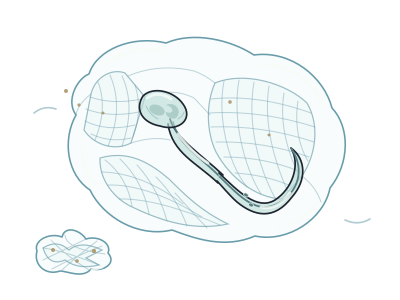
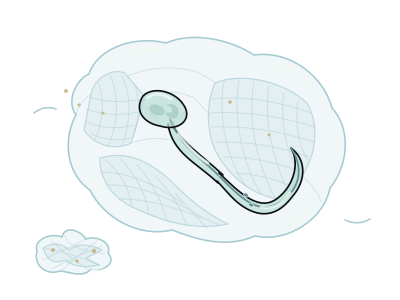
- PyrosomeA glowing tube made of thousands of clones that flashes blue-green when touched.
- Golden star tunicateLives in star-shaped clusters and can regrow a whole body from its blood vessels.
- Predatory tunicateA deep-sea sea squirt whose hood-shaped mouth snaps shut on drifting animals like a flytrap.