An extinct species
Priscomyzon †
Priscomyzon riniensis
A tiny ancient relative with a familiar sucker mouth
Lived about 360–358 million years ago.
You and the priscomyzon meet in the Vertebrates branch, shown at about 520 million years ago (on 16 November, in a calendar from life's shared ancestor to today).
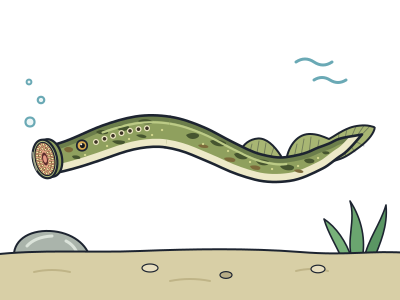
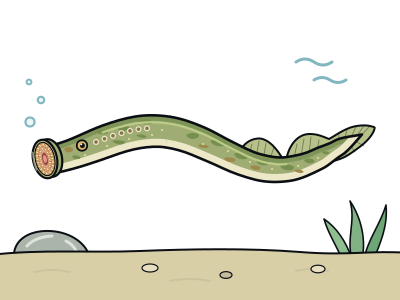
A tiny relative of today's sea lamprey already had a recognisable sucker mouth about 360 to 358 million years ago, near the end of the Devonian period. The family resemblance was striking. But an ancient mouth design did not mean that lampreys had stopped evolving.
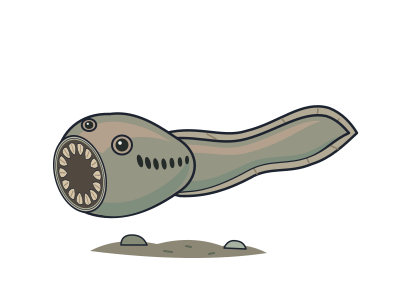
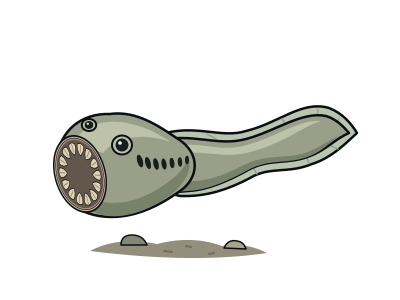
The original fossil preserved a nearly complete, flattened impression of its soft body, rather than a skeleton assembled from bones. It measured about 4.2 centimetres long—roughly the length of a thumb. Its broad head and narrowing body gave it rather tadpole-like proportions. A single fin fold ran along its back and into its tail. Later fossils recorded several stages of growth, from hatchlings to adults.
It lived in a coastal estuary, where river water met the sea, at what is now Waterloo Farm near Makhanda in South Africa. Its fossils offered a rare look at the bodies of these small, soft-bodied relatives of living lampreys.
Fourteen mouth plates
Its mouth contained 14 grooved, petal-shaped plates with tooth-like points.
Seven pairs
Parts of its gill-supporting framework suggested that it had seven pairs of gill pouches.
A local name
Its species name honoured Rini, the Xhosa name for Grahamstown and its surrounding valley.