An extinct species
Pikaia †
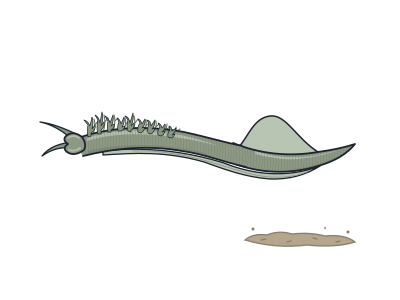
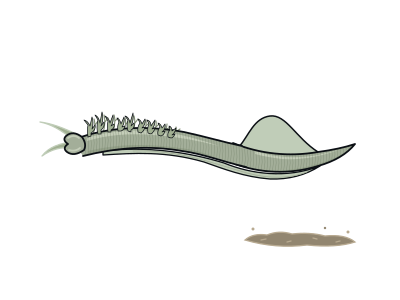
Pikaia gracilens
A tiny swimmer once hailed as our earliest ancestor.
Lived about 508–505 million years ago.
You and the pikaia meet in the Chordates branch, shown at about 550 million years ago (on 14 November, in a calendar from life's shared ancestor to today).
About as long as a child’s little finger, this Burgess Shale swimmer was once hailed as our earliest ancestor. That claim went beyond what its fossils could show. It was better understood as an early relative in the wider chordate family, which included lancelets, sea squirts and animals with backbones—including us.
It lived in Cambrian seas. Different estimates put its fossils at about 508 to 505 million years old. Its slender body was flattened from side to side, rather like a narrow ribbon. Closely spaced, bent bands in the fossils marked the edges of repeated muscle blocks. Its body shape and muscles suggested it could swim, perhaps near the sea floor.
Its soft body survived mainly as thin, carbon-rich films and mineral films in rock, rather than as bones or a shell. These preserved outlines and internal traces, but they did not provide a clear picture of every organ.
A tiny head
Fossils showed a two-lobed head with two slender, tentacle-like projections. No eyes were securely identified.
First called a worm
Charles Walcott first described it as a worm in 1911. Its proposed place in our wider family emerged through later research.
More than a hundred clues
The major 2012 study examined 114 fossils. About 70% included both matching halves of the split fossil-bearing rock.
Next to it on the tree
- VertebratesAnimals with a backbone and a skull: fish, frogs, reptiles, birds and mammals.
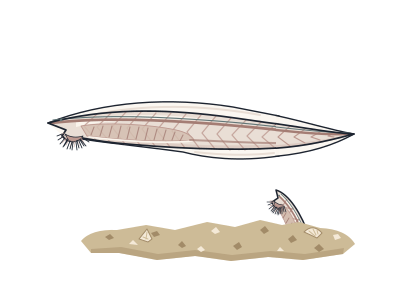
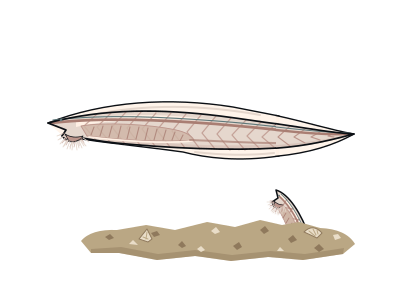
- LanceletA see-through sliver that buries itself in sand: the chordate body plan with nothing extra.
- TunicatesBag-like filter feeders that are our closest relatives without a backbone.


- HaikouichthysOne of the first fish-like animals, an inch long, swimming 518 million years ago.
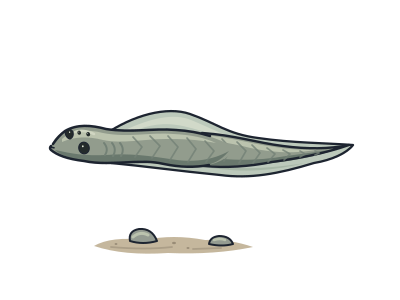
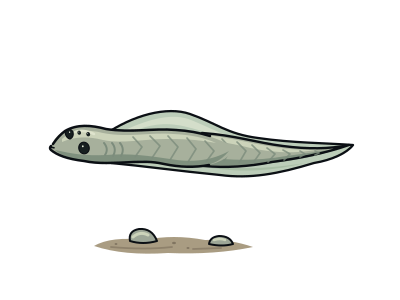
- MetasprigginaA Cambrian swimmer with big eyes and paired gill arches, the bars that later became jaws.