A species
Lancelet
Branchiostoma lanceolatum
A see-through sand-dweller with a body plan shared by us.
You and the lancelet meet in the Chordates branch, shown at about 550 million years ago (on 14 November, in a calendar from life's shared ancestor to today).
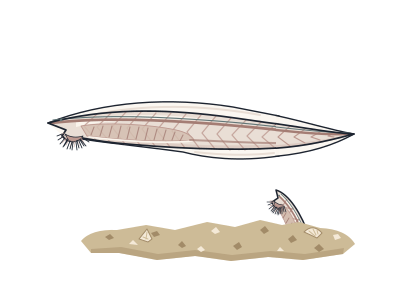
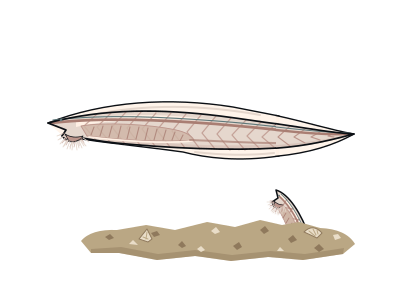
A see-through sliver buried in sand might seem an unlikely relative of yours. Yet the lancelet belongs to the chordates, the same major animal group as humans, fishes and sea squirts. Its pointed body looks fish-like, but it is not a fish: it has no backbone.
Instead, a flexible supporting rod called a notochord runs almost from tip to tip and stays throughout its life. A hollow nerve cord lies above it, along the back. This arrangement is part of the shared chordate body plan. V-shaped blocks of muscle line both sides, much as they do in fishes. Its translucent body lets you see internal structures.
Adults spend most of their time tucked into sand, leaving their front end exposed to filter food from seawater. Their food includes microscopic algae and tiny scraps of organic material. They are not fixed in place: they can swim through open water and move through the sand.
No central heart
Muscular walls in its blood vessels pulse to move blood, rather than relying on a central pumping heart.
A swimming start
The young spend a free-swimming stage among the plankton before settling into life on the seabed.
Picky about sand
It favours coarse sand containing shell fragments rather than fine, muddy sediment.
Next to it on the tree
- VertebratesAnimals with a backbone and a skull: fish, frogs, reptiles, birds and mammals.
- TunicatesBag-like filter feeders that are our closest relatives without a backbone.


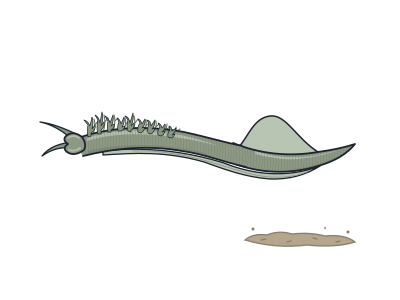
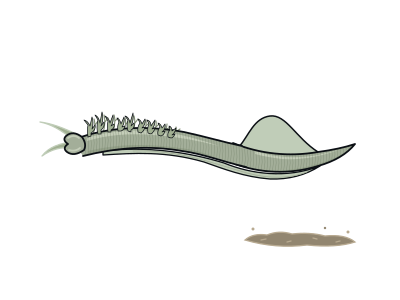
- PikaiaA finger-long Cambrian swimmer from the Burgess Shale, once hailed as our earliest ancestor.
- HaikouichthysOne of the first fish-like animals, an inch long, swimming 518 million years ago.
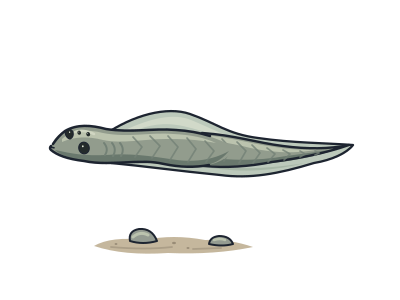
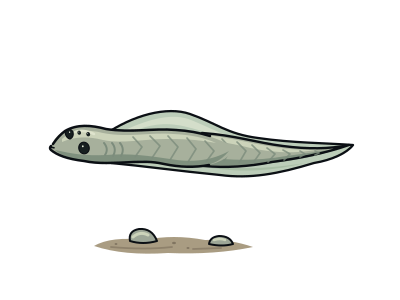
- MetasprigginaA Cambrian swimmer with big eyes and paired gill arches, the bars that later became jaws.