A species
Ocean ammonia-eater
Nitrosopumilus maritimus
One of the most common cells in the sea, quietly recycling the ocean's nitrogen.
You and the ocean ammonia-eater meet in the Archaea branch, shown at about 3.3 billion years ago (on 20 March, in a calendar from life's shared ancestor to today).
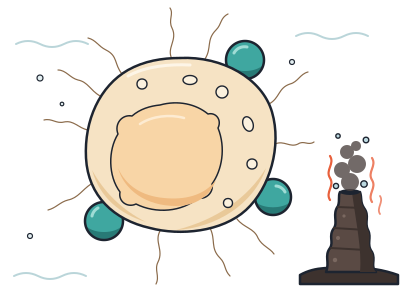
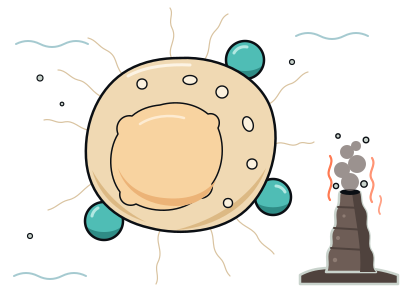
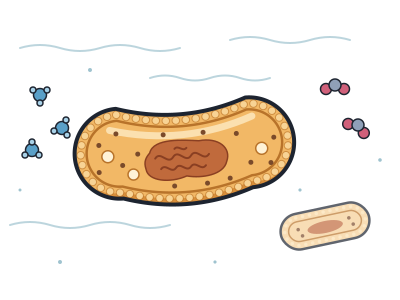
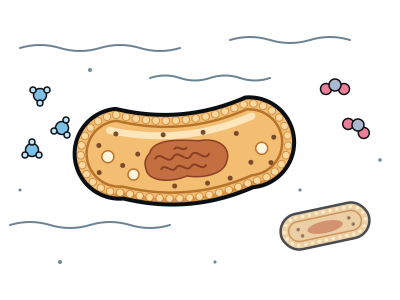
Scoop up a bucket of seawater and you will be holding huge numbers of tiny cells like this one. The ocean ammonia-eater belongs to a group of archaea that can make up about one in every five microbes in the sea. In deeper water their share is often even higher. These cells take in ammonia, which comes from waste and decay, and turn it into nitrite. This is the first step in recycling nitrogen, a nutrient that ocean life needs to grow.
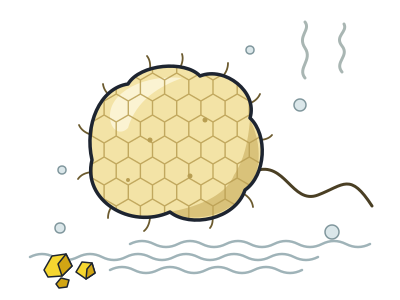
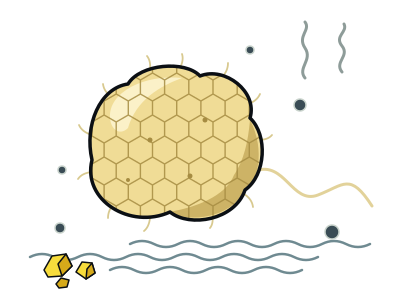
Archaea are a separate branch of life from bacteria, even though the two look alike under a microscope. Many people think of archaea as lovers of extreme places like hot springs. That is where its relative Sulfolobus, shown beside it, lives. The ocean ammonia-eater lives in ordinary seawater instead, and it does well where nutrients are scarce.
It is one of the smallest living cells known: a little rod so thin that a few hundred could lie side by side across a human hair. It has no tail for swimming, and nobody has seen it move. It makes its own food from carbon dioxide, a bit like a plant but without light. Its way of doing this uses about one-third less energy than the method plants use.
Found in a fish tank
In 2005 scientists first grew it in the lab from gravel in a tropical fish tank at the Seattle Aquarium. In 2018 the aquarium put up a plaque near that tank to mark the discovery.
Oxygen in the dark
In 2022 scientists showed that it can make oxygen without sunlight. After using up the oxygen in its water, it made a small amount of new oxygen, which it then used itself.
A whiff of greenhouse gas
As a by-product of its work, it gives off a small amount of nitrous oxide, which is a greenhouse gas.