An extinct species
Meganeuropsis †
Meganeuropsis permiana
The insect with the biggest wings ever found, a giant relative of today's dragonflies
Lived about 290–283 million years ago.
You and the meganeuropsis meet in the Two-sided animals branch, shown at about 580 million years ago (on 11 November, in a calendar from life's shared ancestor to today).
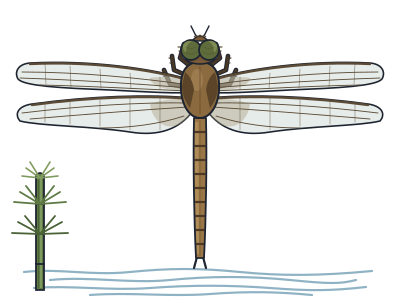
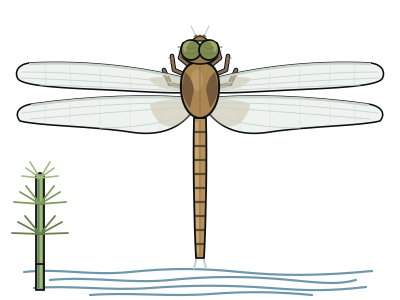
No insect we know of had bigger wings than this one. Its wings stretched about 70 cm from tip to tip, about five times wider than a typical dragonfly today. It lived about 290 to 283 million years ago in what is now Kansas, USA. That was tens of millions of years before the first dinosaurs.
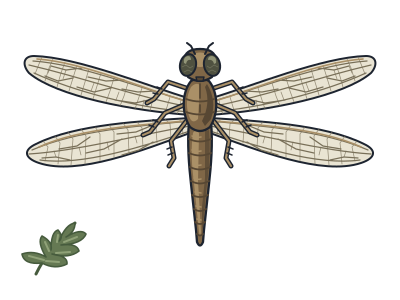
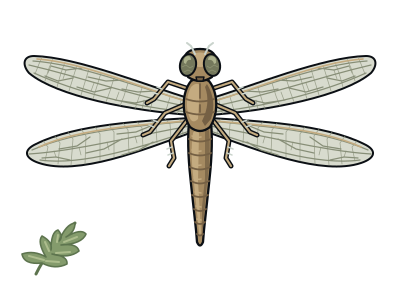
It looked like a giant dragonfly, but it was not a true dragonfly. It belonged to the griffinflies, an early side branch of the dragonfly family line. Griffinflies were relatives of modern dragonflies, not their ancestors.
All we have of this species are wings, preserved as impressions in rock. The first were found at Elmo, Kansas, in 1937. Scientists estimate that each wing was about 33 cm long, a little longer than a school ruler.
Its body is pictured from better-preserved griffinfly relatives. Those fossils show huge eyes that met at the top of the head, strong toothed jaws and spiny legs. Modern 'hawker' dragonflies use the same tools to catch prey in mid-air. So scientists think it was probably a flying hunter too, catching prey on the wing in open places.
As long as a ruler and a half
From head to tail end, its body is estimated at about 41 to 43 cm long.
Today's giants are small
The biggest living dragonfly-type insect is a giant damselfly from Central and South America. Its wings span only up to about 19 cm, less than a third of this griffinfly's.
A lost group
Griffinflies did not survive past the Permian. They disappeared around the time of the great crisis at the end of that period, roughly 252 million years ago.