A species
Desert locust
Schistocerca gregaria
A shy grasshopper with a swarming side
You and the desert locust meet in the Two-sided animals branch, shown at about 580 million years ago (on 11 November, in a calendar from life's shared ancestor to today).
A desert locust is a grasshopper that usually keeps away from its own kind. But crowd enough together and they begin seeking one another out, eventually forming swarms that can contain billions. The quiet loner and the swarming traveller are the same species. Both belong among the winged insects, alongside other branches such as dragonflies and earwigs.
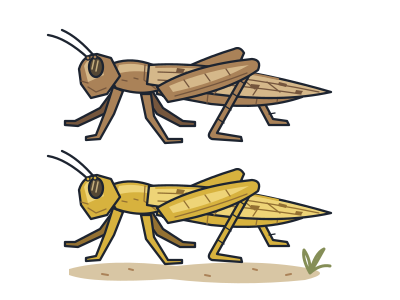
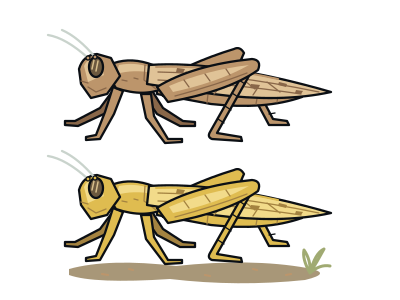
This change does not happen all at once. Behaviour can shift within hours. Colour changes take longer, and some differences in body shape take several generations to develop fully. Adults living alone are usually brown. Swarming adults are generally pink before they are ready to breed, then yellow once mature. The change between solitary and group-living forms is reversible.
Rain can set the scene by bringing fresh plant growth and rising locust numbers. As plants become concentrated in shrinking patches, the insects are pushed together. A grasshopper that normally avoids company can then become drawn to its neighbours.
Growing wings
Young locusts, called hoppers, have no working wings. They shed their outer covering several times before becoming flying adults.
Different flight times
Solitary adults usually make travelling flights at night. Adult swarms usually fly during daylight.
A long-hidden connection
In the 1920s, scientists showed that desert locusts could change between solitary and swarming forms.
Next to it on the tree
- Common field grasshopperThe summer chirper of dry grassland, singing with a comb on its back legs.
- Eastern lubber grasshopperA big, slow, brightly coloured grasshopper that hisses and froths when grabbed.
- Rainbow grasshopperA painted-looking prairie grasshopper whose bold colours warn birds off.
- Rocky Mountain locustOnce formed the largest swarm ever recorded, then vanished completely by about 1902.